
Op 30 september 2025 kreeg EMN België, op uitnodiging van Enabel, de gelegenheid om de specifieke kenmerken van zijn netwerkgerichte aanpak toe te lichten aan vertegenwoordigers uit Ivoorkust en Mauritanië, die België bezochten in het kader van een uitwisselingsbezoek rond inclusie en (re)integratie.
Lees meer
Hoofdthema: Cross-sectionaal, Asiel, Migratie
Trefwoorden: EMN België, netwerk

The Flemish government has decided that third-country workers – from outside the EU, Iceland, Liechtenstein, Norway and Switzerland – will follow a mandatory tailored integration trajectory from 2027. The initiative, proposed by Minister Hilde Crevits, will be delivered digitally and can be started in the country of origin or within six months of arrival in Flanders. The programme provides essential information on work, rights and responsibilities, and Flemish norms and values. Certain temporary or seasonal workers, students, and holiday-work participants are excluded.
Lees meer
Hoofdthema: Integration, Economic migration
Trefwoorden: migrant worker, self-employed, integration programme, digital learning
The Fedasil Info Point in Brussels has been supporting asylum seekers and other migrants for two years, providing accessible and centralised information in one location. Since reopening on 27 September 2023 at the former Bordet Hospital site, it has welcomed over 22.000 visitors, mostly single men with ongoing asylum procedures. Visitors most frequently ask about accommodation, medical care, legal support, and other practical matters. Partners such as Caritas International and the European Union Agency for Asylum (EUAA) assist in providing guidance and support.
Lees meer
The Presidency of the Council and European Parliament negotiators have reached a provisional agreement to enhance Europol’s role in supporting Member States against migrant smuggling and human trafficking. The deal focuses on improving information sharing and operational coordination at EU level. A European Centre Against Migrant Smuggling will be established within Europol. The agreement must still be formally approved by both the Council and the European Parliament.
Lees meer
Hoofdthema: Smuggling & Trafficking
Trefwoorden: Europol, mandate, information sharing, European Centre Against Migrant Smuggling

Myria, the Federal Migration Centre, has published a thematic report on economic migration, free movement and students as part of its annual report "Migration in figures and rights 2025". The publication explains trends in labour migration and study-related mobility. It shows that labour migration from outside the EU has slightly decreased, the share of third-country nationals among temporary postings has continued to grow, and student numbers are increasing.
Lees meer
Hoofdthema: Economic migration, Study § Training
Trefwoorden: Myria, annual report, labour migration, student migration, temporary posting
According to Statbel, the Belgian statistical office, 5.523 persons obtained Belgian nationality in June 2025. The main countries of origin of people who acquired Belgian nationality in June are Morocco, Syria, Romania, Italy and Turkey.
Lees meer
Hoofdthema: Data & Statistics, Citizenship & Nationality
Trefwoorden: access to nationality, Belgian nationality
The Belgian Minister for Equal Opportunities, Rob Beenders, has launched a campaign aimed at employers, HR professionals and relevant actors to promote gender equality in the workplace. It particularly highlights the challenges faced by women of foreign origin and draws on a recent report showing that they encounter structural difficulties, such as precarious work and under-employment. A podcast complements the campaign by giving a voice to migrant women and illustrating their resilience in the face of these obstacles.
Lees meer
Hoofdthema: Vulnerable groups
Trefwoorden: migrant women, labour market, gender equality, inclusion
Minister Van Bossuyt updates Parliament on internal checks against irregular and secondary migration

Belgium introduced targeted internal checks in July 2025 to address irregular and secondary migration. The measures are applied at airports, international bus and rail stations, and motorway rest areas. Over 11.000 individuals have been checked, with some ordered to leave the territory or placed in closed centres. The government plans to continue the checks and to conduct a six‑month evaluation.
Lees meer
Hoofdthema: Borders & Visa, Irregular Migration
Trefwoorden: checks, Belgian territory, irregularly staying third-country national, secondary movement

The Committee of Ministers of the Council of Europe examined the execution of the European Court of Human Rights judgment in Camara v. Belgium. The case highlighted a systemic failure to enforce judicial decisions ordering the State to provide accommodation and material support to asylum-seekers. While some progress has been made in freeing up reception places and improving operational support, concerns persist over reductions in capacity and the risk to the rule of law. The Committee urged the Belgian authorities to adopt sustainable measures and provide detailed information on enforcement.
Lees meer
Hoofdthema: Reception
Trefwoorden: reception crisis, Camara, reception place, rule of law, reception network
The Council of the European Union has adopted a recommendation outlining a common framework for the gradual transition of displaced Ukrainians out of temporary protection. The measures aim to support sustainable return and reintegration in Ukraine when conditions allow, while also facilitating access to other residence statuses for those eligible. The recommendation provides guidance on voluntary return, reintegration support and information systems for displaced persons.
Lees meer
Hoofdthema: Temporary protection, Return & Readmission
Trefwoorden: displaced person, Ukraine, residence permit, voluntary return, reintegration

The European Commission’s proposed Return Regulation introduces measures to increase return rates across the EU. These include extended detention periods, returns to non-EU countries with no prior personal ties, offshore “return hubs”, and obligations for individuals subject to return orders. Over 200 civil society organisations have raised concerns about fundamental rights, legal uncertainty, and disproportionate impacts. They call on EU institutions to withdraw the proposal and reject it in its current form.
Lees meer
Hoofdthema: Return & Readmission
Trefwoorden: return directive, return regulation, return hub, return rate, fundamental right, detention
Eurostat data show that in 2024, the EU issued 3.5 million first residence permits to non-EU citizens, marking an 8.3% decrease compared with 2023, which had recorded the highest number to date. Employment remained the main reason for granting residence permits, while student permits continued to increase slightly.
Lees meer
Hoofdthema: Data & Statistics, Asylum, Migration
Trefwoorden: Eurostat, first residence permit

Myria werft een beleidsmedewerker aan (voltijds – contract van 2 jaar) ter ondersteuning van het Belgisch Contactpunt van het Europees Migratienetwerk (EMN). De functie focust voornamelijk op arbeidsmigratie en gezinshereniging. U draagt in het Engels bij aan het opstellen van rapporten, studies en beleidsdocumenten in een Europese context. De standplaats van de functie is Brussel.
Lees meer
Hoofdthema: Cross-sectionaal, Asiel, Migratie
Trefwoorden: EMN België, vacature
Eight officers from the European Border and Coast Guard Agency (Frontex) have started work at Brussels Airport to assist in return operations. They will operate alongside Belgian police to increase the number of returns. Their deployment follows the adoption of national legislation and a Royal Decree defining their powers and operational zones.
Lees meer
Hoofdthema: Return & Readmission
Trefwoorden: forced return, Frontex, European Border and Coast Guard, Brussels Airport
Asylum applications in EU+ countries fell by nearly a quarter in the first half of 2025, according to the European Union Agency for Asylum (EUAA). A sharp decline in requests from Syrians, following political change in the country, shifted the profile of applicants across Europe. Venezuelans became the largest group seeking protection, while Germany lost its position as the main destination country. Recognition rates reached a record low, reflecting procedural factors and changes in applicant composition.
Lees meer

On 4 September, the non-profit organisation Mentor Jeunes held an online information session for families willing to foster unaccompanied foreign minors. The initiative highlighted foster care as an alternative to collective centres, offering children a safe and structured home environment. It also explained the individualised support available to both families and young people, aiming to encourage more households to consider joining the programme.
Lees meer
Hoofdthema: Vulnerable groups
Trefwoorden: unaccompanied foreign minor, foster family
From 1 September 2025, the filing fee for appeals before Belgium’s Council for Alien Law Litigation will increase from €186 to €251, marking a rise of approximately 35%. The fee for parties wishing to intervene in ongoing cases will also increase, from €133 to €180. Legal practitioners are advised to inform clients of the new rates. Questions remain over the impact of these increases on access to justice for vulnerable individuals.
Lees meer
Hoofdthema: Cross-sectional, Asylum, Migration
Trefwoorden: Council for Alien Law Litigation, appeal procedure, fee
Red Cross Flanders has opened 156 new cases this year concerning families who lost contact due to war, violence or migration, involving 337 individuals. The organisation works to reconnect families separated under these circumstances. Currently, 671 cases remain open in Flanders, while the international Red Cross network manages over 250.000 cases worldwide. Efforts cover more than twenty countries, including Ukraine, Afghanistan and Congo.
Lees meer
Hoofdthema: Family reunification
Trefwoorden: missing person, family tie, family member, family tracing
In August 2025, the European Union Agency for Asylum (EUAA) introduced a Self-Assessment Tool to help national authorities evaluate the quality of their asylum procedures. Based on EUAA operational standards and indicators, the tool provides a structured method for self-assessment. It aims to help administrations identify areas for improvement and ensure compliance with EU standards. A descriptive version of the tool is currently available to guide implementation.
Lees meer
Hoofdthema: International Protection
Trefwoorden: asylum procedure, international protection procedure, quality, self-assessment
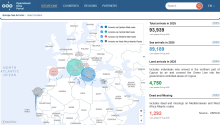
Did you know that the UNHCR Operational Data Portal provides detailed, up-to-date information on sea arrivals in Europe? As of 24 August 2025, a total of 89.189 people have reached European shores by sea. The majority of these arrivals have been recorded in Italy and Greece, while Spain also received significant numbers. In 2024, a total of 187.337 sea arrivals were reported, illustrating the continued importance of Mediterranean and North-West African routes.
Lees meer
Hoofdthema: Irregular Migration
Trefwoorden: UNHCR, operational data portal, sea arrival, land arrival
In the first half of 2025, West Flanders saw 72 transit migrants intercepted, a significant decrease compared with previous years. Most were from Ethiopia, while earlier periods involved people from Sudan, Iraq and Vietnam. Authorities cite preventive policing and cross-border controls as key factors.
Lees meer
Hoofdthema: Irregular Migration, Smuggling & Trafficking
Trefwoorden: transit migrant, transmigrant, interception, border control
From 18 August 2025, new rules for family reunification enter into force in Belgium. They do not apply to all applicants. Some cases continue under the old rules, others transition to the new rules in 2027, while certain applications are immediately subject to the new framework. This article explains who is affected and how the rules will change.
Lees meer
Hoofdthema: Family reunification
Trefwoorden: application for family reunification, family tie, income requirement, minimum age, housing
The term “instrumentalisation of migrants” describes a strategy where countries outside the EU use the movement of people to put political pressure on the Union or one of its Member States. This has happened at several borders in recent years and has had real human consequences. A new paper from the EU Agency for Fundamental Rights (FRA) explains what the phenomenon is, the dilemmas it creates, and why responses must strike a careful balance.
Lees meer
Hoofdthema: Cross-sectional, Asylum, Migration
Trefwoorden: instrumentalisation, migrant, refugee, fundamental right
According to Statbel, the Belgian statistical office, 4.923 persons obtained Belgian nationality in May 2025. The main countries of origin of people who acquired Belgian nationality in May are Morocco, Romania, Syria, Turkey and Italy.
Lees meer
Hoofdthema: Data & Statistics, Citizenship & Nationality
Trefwoorden: access to nationality, Belgian nationality
A European pilot project is underway to improve access to sustainable housing for beneficiaries of international protection and beneficiaries of temporary protection. Running from November 2024 to October 2027, PATHS brings together IOM, Orbit and Fedasil in Belgium, with partners in France and Greece. The initiative focuses on preventing homelessness through housing platforms, stronger intermediary organisations and greater engagement with property owners.