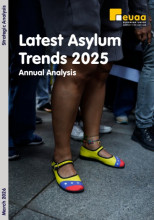
Publication date: 03 March 2026
The Latest Asylum Trends 2025 provides an annual overview of asylum activity in EU+ countries, covering asylum applications (per capita), the main nationalities of applicants, the top receiving countries, recognition rates, pending cases and the number of beneficiaries of temporary protection following the war in Ukraine. It also reviews policy developments in the EU+ and provides a 2026 outlook, examining, inter alia, geopolitical uncertainty and latent displacement risks.
Read more
Main theme: International Protection, Temporary protection
Publication Type: Report
Keywords: Latest Asylum Trends, EUAA, asylum applications, recognition rate, pending cases, displaced person, Ukraine, New Pact on Migration and Asylum
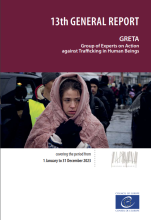
Publication date: 29 April 2024
The general report 2023 of the Council of Europe's Group of Experts on Action against Trafficking in Human Beings (GRETA) includes a stocktaking of the third evaluation round of the Convention, which focused on trafficking victims’ access to justice and effective remedies. GRETA analyses trends emerging from its country reports, drawing attention to gaps in the implementation of the Convention, as well as promising practices.
Read more
Main theme: Smuggling & Trafficking
Publication Type: Report
Keywords: GRETA, access to justice, effective remedy, vulnerability, displaced person
Publication date: 27 February 2023
This Inform explores which national strategies, successful programmes and initiatives have been implemented in the EMN Member Countries to enhance the prospects for displaced persons in non-EU first reception and transit countries, and how these strategies have been integrated within existing EU and international frameworks and agreements.
Read more
Main theme: External Dimension
Publication Type: Informs
Keywords: displaced person, first reception country, transit country
Publication date: 01 December 2009
This study examines the protection statuses granted in Belgium, including those harmonized at European level and those set at the national level in the framework of asylum and immigration policies. It addresses the legal basis, procedures and rights attached to these statuses.
Read more
Main theme: International Protection
Publication Type: Thematic Studies
Keywords: displaced person, protection need, qualification directive, refugee, residence permit, rights

Publication date:
According to the Latest Asylum Trends 2025 published by the European Union Agency for Asylum (EUAA), EU+ countries received approximately 822.000 applications for international protection in 2025, representing a 19 % decrease compared to 2024. Despite the overall decline, demand for protection remained significant in some groups and countries.
Read more

Publication date:
The EMN Hungary Conference will explore how EU temporary protection frameworks are evolving and how these changes are implemented in practice across Central Europe. It aims to connect high-level policy developments with on-the-ground realities for displaced persons and host communities. The conference will examine potential transitions from the EU temporary protection regime and highlight regional practices, challenges, and successful approaches.
Read more
Main theme: Temporary protection
Keywords: temporary protection, Central Europe, displaced person, host community

Publication date:
The Council of the European Union has adopted a recommendation outlining a common framework for the gradual transition of displaced Ukrainians out of temporary protection. The measures aim to support sustainable return and reintegration in Ukraine when conditions allow, while also facilitating access to other residence statuses for those eligible. The recommendation provides guidance on voluntary return, reintegration support and information systems for displaced persons.
Read more
Main theme: Temporary protection, Return & Readmission
Keywords: displaced person, Ukraine, residence permit, voluntary return, reintegration

Publication date:
On 4 June 2025, the European Commission proposed extending temporary protection for displaced persons fleeing the conflict in Ukraine until 4 March 2027. The proposal aims to provide legal certainty to beneficiaries and Member States by maintaining a consistent standard of protection across the European Union. Additionally, the Commission proposed a set of measures to facilitate a coordinated transition out of temporary protection.
Read more
Main theme: Temporary protection
Keywords: Ukraine, displaced person, beneficiary of temporary protection, legal status, voluntary return, reintegration
Publication date:
The 2023 Innovation Awards were awarded at the IOM Global Chiefs of Missions Meeting (GCOMM) in Istanbul on 25 October 2023. In the category "Regular Pathways", Displaced Talent for Europe (DT4E), which facilitates skilled migration for displaced talent to respond to labour market shortages, was acknowledged as the changemaker.
Read more
Main theme: Economic migration
Keywords: regular pathway, skilled migrants, displaced person, labour market shortage
Publication date:
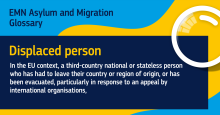
The European Migration Network (EMN) Glossary is an essential resource, which offers an EU-wide multidisciplinary vocabulary of approximately 500 terms and concepts related to asylum and migration. Let's focus today on the term "displaced person" to make sure we have a common understanding and use of the term!