Publication date: 07 November 2025
This ad hoc query examines the approaches taken by EMN Member Countries regarding potential changes to support measures for beneficiaries of temporary protection (BoTPs) with respect to accommodation and social welfare. It examines whether changes were applied retroactively and whether different levels of support persist across groups. The query investigates the existence of differentiated support for vulnerable BoTPs and how vulnerability is defined and assessed.
Read more
Main theme: Reception, Temporary protection
Publication Type: Ad Hoc Queries
Keywords: beneficiary of temporary protection, vulnerability, accommodation, social benefits
Publication date: 26 November 2024
The European Migration Network (EMN) study looks at whether EMN Member Countries implemented any changes in the application of the Temporary Protection Directive (TPD) in 2023 (as compared to 2022) and also aims to identify continued challenges, as well as good practices.
Read more
Main theme: Temporary protection
Publication Type: Thematic Studies
Keywords: Temporary Protection Directive, beneficiary of temporary protection, residence permit, access to rights, vulnerability
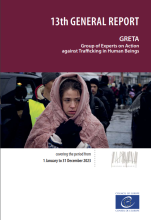
Publication date: 29 April 2024
The general report 2023 of the Council of Europe's Group of Experts on Action against Trafficking in Human Beings (GRETA) includes a stocktaking of the third evaluation round of the Convention, which focused on trafficking victims’ access to justice and effective remedies. GRETA analyses trends emerging from its country reports, drawing attention to gaps in the implementation of the Convention, as well as promising practices.
Read more
Main theme: Smuggling & Trafficking
Publication Type: Report
Keywords: GRETA, access to justice, effective remedy, vulnerability, displaced person
Publication date: 25 April 2024
Through this ad hoc query, the Slovak Republic collects information on EMN Member and Observer countries' experiences in recording data on the vulnerability of applicants for international protection and generating statistical reports related to vulnerability.
Read more
Main theme: Vulnerable groups, International Protection
Publication Type: Ad Hoc Queries
Keywords: applicant for international protection, vulnerability, data collection
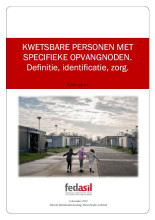
Publication date: 17 December 2018
This final report, realised by the Study and Policy Unit of the Federal Agency for the Reception of Asylum Seekers (Fedasil), describes the reception of vulnerable applicants for international protection with specific needs. It discusses how (field) staff define, identify and respond to vulnerability in practice. The objective is to develop a better understanding of the way in which Fedasil and its reception partners fulfill the requirement of Belgian and European legislation to meet the specific needs of applicants for international protection.
Read more
Main theme: Vulnerable groups
Publication Type: Report
Keywords: reception, special needs, vulnerability
Publication date: 03 April 2018
The GRETA report, covering the period from 1 January until 31 December 2018, stresses that labour exploitation is on the rise across Europe. Also in Belgium, labour exploitation appears as a predominant form of trafficking.
Read more
Main theme: Smuggling & Trafficking
Publication Type: Report
Keywords: labour exploitation, vulnerability, migrant worker

Publication date:
From 3 to 7 November 2025, the Group of Experts on Action against Trafficking in Human Beings (GRETA) conducted an evaluation visit to Belgium under the fourth cycle of its monitoring of the Convention on Action against Trafficking in Human Beings. The evaluation focuses on vulnerabilities to trafficking, the measures taken to prevent and detect them, support victims, and sanction perpetrators, with particular attention to the role of information and communication technologies.
Read more
Publication date:
EMN Portugal’s 2025 Conference will focus on the specific challenges arising from international protection and the integration of beneficiaries. The event will bring together researchers, government agencies, social partners and private sector representatives to exchange knowledge and explore innovative policies and practices. Participants will have the opportunity to discuss national experiences and share successful approaches adaptable to various contexts.
Read more
Main theme: Integration, Vulnerable groups
Keywords: beneficiary of international protection, integration challenge, vulnerability
Publication date:
On 27 October 2025 in Luxembourg, stakeholders will gather to discuss how the EU Pact on Migration and Asylum addresses statelessness as a vulnerability. The meeting will focus on early experiences with implementing the new obligations under the Screening and Asylum Procedures Regulations. Organised under the EMN Platform on Statelessness, it will provide space for exchange among national experts, EU agencies, and international organisations.
Read more
Main theme: Statelessness
Keywords: New Pact on Migration and Asylum, statelessness, vulnerability
Publication date:
During a webinar on 17 September 2024, EMN Member and Observer countries and the Red Cross highlighted key practices and challenges in identifying victims of torture in the context of international and temporary protection. The experience of migrant torture survivors was further examined and ways to address their vulnerabilities were discussed.
Read more
Main theme: Vulnerable groups
Keywords: victim, torture, traumatism, applicant for international protection, credibility assessment, vulnerability, special needs
Publication date:
An IOM-Harvard report shows that close to half of the child victims of trafficking were being trafficked for forced labour (mainly boys), in a wide range of industries, such as domestic work, begging and agriculture. Sexual exploitation, including through prostitution, pornography, and sexual servitude, is also prominent, affecting 20 per cent of trafficked children, predominantly girls.