EMN and the Red Cross discuss better ways to identify and consider the vulnerabilities of victims of torture in the international and temporary protection procedures
During a webinar on 17 September 2024, EMN Member and Observer countries and the Red Cross highlighted key practices and challenges in identifying victims of torture in the context of international and temporary protection. The experience of migrant torture survivors was further examined and ways to address their vulnerabilities were discussed.
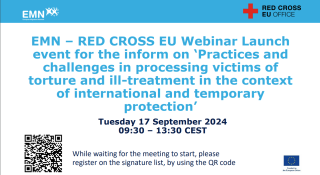
The European Migration Network (EMN) and the Red Cross recently published an Inform on “Practices and challenges in identifying victims of torture and ill-treatment in the context of international and temporary protection”. In this context, they gathered around 130 persons during a webinar on 17 September 2024 to share the conclusions of this Inform and deepen exchanges thanks inter alia to the expertise of medical and legal professionals working with survivors of torture.
First of all, the key findings from the above-mentioned Inform were briefly presented. Some positive aspects were underlined, for example, the fact that most countries provide national training programmes for competent authorities in detecting victims of torture. Some challenges remain however worrying, particularly victims’ hesitancy to report and their lack of trust in authorities as well as difficulties in assessing the credibility of torture claims.
Then experts from the EUAA, France and Italy presented useful publications, practices and tools relating to this issue. The EUAA shared some conclusions from the EUAA’s mapping report on Victims of Torture from 17 March 2023, emphasizing inter alia the lack of self-reporting and the importance, to remedy this, of (i) providing more expertise, guidance and staff, (ii) offering small-scale and safe accommodation and (iii) favouring a human approach during interviews. France explained the support that the group of experts on torture and traumatism provides in the examination of asylum applications by alleged victims of torture and applicants with trauma. Italy presented the Handbook for the identification, referral and care of persons living with vulnerabilities.
Professionals provided insights into the experience of migrant torture survivors. The International Rehabilitation Council for Torture Victims (IRCT) stressed inter alia how difficult it is for these persons to give a consistent account of their experience while discrepancies may work against them in the status determination process. The Swedish Red Cross particularly underlined that persons suffering from post-traumatic stress disorder try to stay away from persons, places and situations that could trigger intrusive memories, including interviews which require them to speak about traumatic events. Parcours d’exil explained the difficulties medical professionals experience when being requested to provide evidence and certification while providing patient care.
Finally, ways of addressing the vulnerabilities of migrants were discussed. The European Union Agency for Fundamental Rights (FRA) and ECRE reflected on provisions in the New Pact on Migration and Asylum aimed at taking vulnerabilities and special needs into consideration. The Swedish Red Cross highlighted post-migration stressors to be taken into account in the asylum system (uncertainty, difficult interviews, lengthy process, life in limbo, inactivity, worries about family members etc.).
For further information, please read the Inform on “Practices and challenges in identifying victims of torture and ill-treatment in the context of international and temporary protection”.