
Publication date:
On 4 September, the non-profit organisation Mentor Jeunes held an online information session for families willing to foster unaccompanied foreign minors. The initiative highlighted foster care as an alternative to collective centres, offering children a safe and structured home environment. It also explained the individualised support available to both families and young people, aiming to encourage more households to consider joining the programme.
Read more
Main theme: Vulnerable groups
Keywords: unaccompanied foreign minor, foster family

Publication date:
This conference aims to facilitate discussion among authorities and experts on labour migration and the response to labour market needs through sustainable and effective migration policies on a national and EU level. Selected institutions and experts will address the labour market trends and workforce needs in Cyprus and the EU, the challenges and opportunities of legal migration pathways for Cyprus, and EU best practices.
Read more
Main theme: Economic migration
Keywords: labour migration, labour market need, workforce, legal migration pathway

Publication date:
From 1 September 2025, the filing fee for appeals before Belgium’s Council for Alien Law Litigation will increase from €186 to €251, marking a rise of approximately 35%. The fee for parties wishing to intervene in ongoing cases will also increase, from €133 to €180. Legal practitioners are advised to inform clients of the new rates. Questions remain over the impact of these increases on access to justice for vulnerable individuals.
Read more
Main theme: Cross-sectional, Asylum, Migration
Keywords: Council for Alien Law Litigation, appeal procedure, fee
Publication date:
In August 2025, the European Union Agency for Asylum (EUAA) introduced a Self-Assessment Tool to help national authorities evaluate the quality of their asylum procedures. Based on EUAA operational standards and indicators, the tool provides a structured method for self-assessment. It aims to help administrations identify areas for improvement and ensure compliance with EU standards. A descriptive version of the tool is currently available to guide implementation.
Read more
Main theme: International Protection
Keywords: asylum procedure, international protection procedure, quality, self-assessment
Publication date:
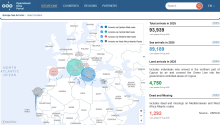
Did you know that the UNHCR Operational Data Portal provides detailed, up-to-date information on sea arrivals in Europe? As of 24 August 2025, a total of 89.189 people have reached European shores by sea. The majority of these arrivals have been recorded in Italy and Greece, while Spain also received significant numbers. In 2024, a total of 187.337 sea arrivals were reported, illustrating the continued importance of Mediterranean and North-West African routes.
Read more
Main theme: Irregular Migration
Keywords: UNHCR, operational data portal, sea arrival, land arrival
Publication date:
In the first half of 2025, West Flanders saw 72 transit migrants intercepted, a significant decrease compared with previous years. Most were from Ethiopia, while earlier periods involved people from Sudan, Iraq and Vietnam. Authorities cite preventive policing and cross-border controls as key factors.
Read more
Main theme: Irregular Migration, Smuggling & Trafficking
Keywords: transit migrant, transmigrant, interception, border control
Publication date:
Fedasil is organising an exhibition on voluntary return and reintegration at the Wintercircus. The Ghent-based Magnum photographer Carl De Keyzer portrays the stories of, among others, Rosa from El Salvador and Igis from Albania. This exhibition is organised in collaboration with Caritas International and the International Organization for Migration, with the support of AMIF.
Read more
Main theme: Return & Readmission
Keywords: voluntary return, reintegration, photo, exhibition
Publication date:
From 18 August 2025, new rules for family reunification enter into force in Belgium. They do not apply to all applicants. Some cases continue under the old rules, others transition to the new rules in 2027, while certain applications are immediately subject to the new framework. This article explains who is affected and how the rules will change.
Read more
Main theme: Family reunification
Keywords: application for family reunification, family tie, income requirement, minimum age, housing

Publication date:
The term “instrumentalisation of migrants” describes a strategy where countries outside the EU use the movement of people to put political pressure on the Union or one of its Member States. This has happened at several borders in recent years and has had real human consequences. A new paper from the EU Agency for Fundamental Rights (FRA) explains what the phenomenon is, the dilemmas it creates, and why responses must strike a careful balance.
Read more
Main theme: Cross-sectional, Asylum, Migration
Keywords: instrumentalisation, migrant, refugee, fundamental right
Publication date:
According to Statbel, the Belgian statistical office, 4.923 persons obtained Belgian nationality in May 2025. The main countries of origin of people who acquired Belgian nationality in May are Morocco, Romania, Syria, Turkey and Italy.
Read more
Main theme: Data & Statistics, Citizenship & Nationality
Keywords: access to nationality, Belgian nationality
Publication date:
A European pilot project is underway to improve access to sustainable housing for beneficiaries of international protection and beneficiaries of temporary protection. Running from November 2024 to October 2027, PATHS brings together IOM, Orbit and Fedasil in Belgium, with partners in France and Greece. The initiative focuses on preventing homelessness through housing platforms, stronger intermediary organisations and greater engagement with property owners.
Read more
Main theme: Reception
Keywords: housing shortage, suitable housing, beneficiary of international protection, beneficiary of temporary protection
Publication date:
The European Commission has formally established the Network for the Prevention of Child Sexual Abuse. This expert group will bring together policymakers, practitioners and researchers to tackle abuse both online and offline. Prevention efforts aim to protect children and address potential offending behaviour. The initiative forms part of the EU Strategy for a more effective fight against child sexual abuse.
Read more

Publication date:
From 4 August 2025, Belgium implements two changes affecting international protection procedures. The period to justify absence from personal interviews is reduced from 15 to 8 days. In addition, new applications submitted after a decision on a previous request in another EU Member State are now registered as subsequent applications.
Read more
The Court of Justice rules that designating a country as ‘safe’ must allow effective judicial review

Publication date:
The Court of Justice of the European Union has ruled that a Member State may designate a third country as a ‘safe country of origin’ by legislative act, provided that the designation can be subject to effective judicial review. The judgment clarifies that the sources used for such a designation must be accessible to both applicants and courts. The Court also stated that a country cannot be listed as ‘safe’ if it does not offer adequate protection to all its population.
Read more
Main theme: International Protection
Keywords: safe country of origin, right to an effective remedy

Publication date:
The European Commission announced that the operations of the Entry/Exit System (EES), an advanced IT system that will digitally record the entries and exits of third-country nationals traveling to 29 European countries for short stays, are set to start on 12 October 2025.
Read more
Main theme: Borders & Visa
Keywords: border management, entry exit system, European Commission

Publication date:
The Office of the Commissioner General for Refugees and Stateless Persons (CGRS) announced that the suspension of processing of applications for international protection from Syria, a measure in place since December 2024, would be extended until the end of October 2025.
Read more
Main theme: International Protection
Keywords: Syria, CGRS, asylum applications, asylum decisions

Publication date:
The Belgian Chamber of Representatives has adopted a law raising the fee for registering the acquisition of Belgian nationality from €150 to €1.000. The change, included in the programme law adopted on 18 July 2025, forms part of a broader package of budgetary measures. The new fee will apply to applications submitted after the law enters into force and will be indexed annually.
Read more
Main theme: Citizenship & Nationality
Keywords: access to nationality, Belgian nationality, registration fee
Publication date:
The Dutch Council of State has ruled that single male asylum seekers may no longer be transferred to Belgium under the Dublin Regulation. The judgment cites systemic failures in Belgium’s reception and legal protection for this group, exposing them to a real risk of inhuman treatment. These individuals must now remain in the Netherlands while their asylum claims are processed.
Read more
Main theme: Reception, International Protection
Keywords: Dublin Regulation, Dublin transfer, shortage, reception place, inhuman treatment
Publication date:
On 23 July, Belgium officially published two new laws aimed at reducing the burden on international protection procedures and limiting access to reception for certain applicants. In particular, these laws redefine which applications are considered subsequent by including those who have already received protection or a final decision in another EU country, and they limit access to reception facilities and material assistance for this group. The laws reflect the government’s intention to streamline asylum processing and manage reception capacity effectively.
Read more
Main theme: Reception, International Protection
Keywords: Aliens Act, subsequent application, Reception Act, material assistance, material reception condition

Publication date:
The Belgian Council of Ministers has approved a draft law enabling home searches, with judicial authorisation, in cases involving non-cooperative foreign nationals facing return and posing a threat to public order or national security. The measure is similar to one previously discussed in 2018 and will now be submitted to the Council of State for its opinion. Several civil society organisations have expressed concerns about its implications.
Read more
Main theme: Return & Readmission
Keywords: home search, forced return, public order, national security, immigration enforcement

Publication date:
The Belgian Chamber of Representatives has adopted new legislation modifying the conditions for family reunification under the law of 15 December 1980. The changes introduce stricter income requirements and modify waiting periods for certain categories of foreign nationals, particularly those benefiting from international or subsidiary protection. The legislation was approved with a majority vote during a plenary session and aims to regulate access to family reunification, a principal legal pathway for foreign nationals to join family members in Belgium.
Read more
Main theme: Family reunification
Keywords: application for family reunification, income requirement, waiting period, age limit

Publication date:
On 3 December 2025 in Stockholm, the EMN Sweden Conference will gather stakeholders to discuss labour shortages and international talent attraction. The event will explore EU and national strategies to address these challenges and strengthen Europe’s competitiveness. Policymakers, experts and practitioners will exchange insights, good practices and new research findings.
Read more
Main theme: Economic migration
Keywords: talent attraction, labour shortages, competitiveness

Publication date:
On 27 October 2025 in Luxembourg, stakeholders will gather to discuss how the EU Pact on Migration and Asylum addresses statelessness as a vulnerability. The meeting will focus on early experiences with implementing the new obligations under the Screening and Asylum Procedures Regulations. Organised under the EMN Platform on Statelessness, it will provide space for exchange among national experts, EU agencies, and international organisations.
Read more
Main theme: Statelessness
Keywords: New Pact on Migration and Asylum, statelessness, vulnerability
EU allocates €81 billion for migration, border management, and internal security in 2028–2034 budget
Publication date:
On 16 July 2025, the European Commission unveiled its proposal for the 2028–2034 Multiannual Financial Framework (MFF), totalling nearly €2 trillion. A significant portion of this budget—approximately €81 billion—is earmarked for migration, border management, and internal security. Within this amount, €34 billion is specifically allocated to migration management, tripling the funding compared to the previous period.
Read more
Main theme: Cross-sectional, Asylum, Migration
Keywords: multiannual financial framework, European Union, budget
Need help understanding asylum and migration jargon? The EMN Glossary is now easier to use than ever
Publication date:
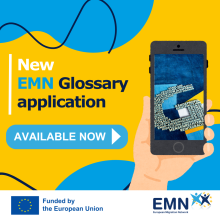
The European Migration Network (EMN) has made its popular Glossary more accessible than ever, now available through a redesigned website and mobile app. With over 540 asylum and migration terms in 27 languages, it helps make complex concepts easier to understand. Whether you're a student, journalist, frontline worker or just curious about asylum and migration in Europe, the EMN Glossary offers clear definitions, trusted translations and smart search features — all for free, and accessible to everyone.