The European Commission has formally established the Network for the Prevention of Child Sexual Abuse. This expert group will bring together policymakers, practitioners and researchers to tackle abuse both online and offline. Prevention efforts aim to protect children and address potential offending behaviour. The initiative forms part of the EU Strategy for a more effective fight against child sexual abuse.
Read more

From 4 August 2025, Belgium implements two changes affecting international protection procedures. The period to justify absence from personal interviews is reduced from 15 to 8 days. In addition, new applications submitted after a decision on a previous request in another EU Member State are now registered as subsequent applications.
Read more
The Court of Justice rules that designating a country as ‘safe’ must allow effective judicial review
The Court of Justice of the European Union has ruled that a Member State may designate a third country as a ‘safe country of origin’ by legislative act, provided that the designation can be subject to effective judicial review. The judgment clarifies that the sources used for such a designation must be accessible to both applicants and courts. The Court also stated that a country cannot be listed as ‘safe’ if it does not offer adequate protection to all its population.
Read more
Main Theme: International Protection
Keywords: safe country of origin, right to an effective remedy

The European Commission announced that the operations of the Entry/Exit System (EES), an advanced IT system that will digitally record the entries and exits of third-country nationals traveling to 29 European countries for short stays, are set to start on 12 October 2025.
Read more
Main Theme: Borders & Visa
Keywords: border management, entry exit system, European Commission

The Office of the Commissioner General for Refugees and Stateless Persons (CGRS) announced that the suspension of processing of applications for international protection from Syria, a measure in place since December 2024, would be extended until the end of October 2025.
Read more
Main Theme: International Protection
Keywords: Syria, CGRS, asylum applications, asylum decisions

The “Blue Heart” is recognised as the international symbol of the fight against human trafficking. On 28 July 2025, the Blue Heart Campaign was launched at Leuven City Hall. EMN Belgium joined local authorities, the three specialised centres for victims of human trafficking, Myria, the UNODC and many other stakeholders on this occasion. The theme of this year is “Human Trafficking is Organized Crime – End the Exploitation”.
Read more
On 23 July, Belgium officially published two new laws aimed at reducing the burden on international protection procedures and limiting access to reception for certain applicants. In particular, these laws redefine which applications are considered subsequent by including those who have already received protection or a final decision in another EU country, and they limit access to reception facilities and material assistance for this group. The laws reflect the government’s intention to streamline asylum processing and manage reception capacity effectively.
Read more
Main Theme: Reception, International Protection
Keywords: Aliens Act, subsequent application, Reception Act, material assistance, material reception condition
The Dutch Council of State has ruled that single male asylum seekers may no longer be transferred to Belgium under the Dublin Regulation. The judgment cites systemic failures in Belgium’s reception and legal protection for this group, exposing them to a real risk of inhuman treatment. These individuals must now remain in the Netherlands while their asylum claims are processed.
Read more
Main Theme: Reception, International Protection
Keywords: Dublin Regulation, Dublin transfer, shortage, reception place, inhuman treatment
The Belgian Council of Ministers has approved a draft law enabling home searches, with judicial authorisation, in cases involving non-cooperative foreign nationals facing return and posing a threat to public order or national security. The measure is similar to one previously discussed in 2018 and will now be submitted to the Council of State for its opinion. Several civil society organisations have expressed concerns about its implications.
Read more
Main Theme: Return & Readmission
Keywords: home search, forced return, public order, national security, immigration enforcement
The Belgian Chamber of Representatives has adopted a law raising the fee for registering the acquisition of Belgian nationality from €150 to €1.000. The change, included in the programme law adopted on 18 July 2025, forms part of a broader package of budgetary measures. The new fee will apply to applications submitted after the law enters into force and will be indexed annually.
Read more
Main Theme: Citizenship & Nationality
Keywords: access to nationality, Belgian nationality, registration fee
The Belgian Chamber of Representatives has adopted new legislation modifying the conditions for family reunification under the law of 15 December 1980. The changes introduce stricter income requirements and modify waiting periods for certain categories of foreign nationals, particularly those benefiting from international or subsidiary protection. The legislation was approved with a majority vote during a plenary session and aims to regulate access to family reunification, a principal legal pathway for foreign nationals to join family members in Belgium.
Read more
Main Theme: Family reunification
Keywords: application for family reunification, income requirement, waiting period, age limit
EU allocates €81 billion for migration, border management, and internal security in 2028–2034 budget
On 16 July 2025, the European Commission unveiled its proposal for the 2028–2034 Multiannual Financial Framework (MFF), totalling nearly €2 trillion. A significant portion of this budget—approximately €81 billion—is earmarked for migration, border management, and internal security. Within this amount, €34 billion is specifically allocated to migration management, tripling the funding compared to the previous period.
Read more
Main Theme: Cross-sectional, Asylum, Migration
Keywords: multiannual financial framework, European Union, budget
Need help understanding asylum and migration jargon? The EMN Glossary is now easier to use than ever
The European Migration Network (EMN) has made its popular Glossary more accessible than ever, now available through a redesigned website and mobile app. With over 540 asylum and migration terms in 27 languages, it helps make complex concepts easier to understand. Whether you're a student, journalist, frontline worker or just curious about asylum and migration in Europe, the EMN Glossary offers clear definitions, trusted translations and smart search features — all for free, and accessible to everyone.
Read more
Main Theme: Cross-sectional, Asylum, Migration
Keywords: glossary, common terminology, website, mobile application
According to Statbel, the Belgian statistical office, 5.336 persons obtained Belgian nationality in April 2025. The main countries of origin of people who acquired Belgian nationality in April are Morocco, Romania, Syria, France and Turkey.
Read more
Main Theme: Data & Statistics, Citizenship & Nationality
Keywords: access to nationality, Belgian nationality
On 11 July, the Belgian Council of Ministers approved a draft bill that broadens the circumstances under which Belgian nationality may be withdrawn. This reform enlarges the list of serious criminal offences that can lead to loss of nationality and mandates judges to systematically consider deprivation in terrorism convictions. The draft bill will now be submitted to the Council of State for its opinion.
Read more
Main Theme: Citizenship & Nationality
Keywords: Belgian nationality, deprivation of nationality, organised crime, terrorism, sexual offence
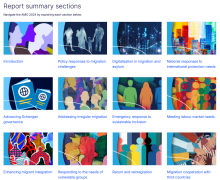
The European Migration Network (EMN) has published its Asylum and Migration Overview 2024, with contributions from 30 Member and Observer Countries. The Belgian and EU-wide reports are both made available today, with the European report presented today 9 July 2025 at an online launch event gathering over 260 participants. For the first time, the EU report is available in an interactive format offering dynamic access to key data and trends.
Read more
Main Theme: Cross-sectional, Asylum, Migration
Keywords: Asylum and Migration Overview, interactive format, interactive map

In 2024, 774 unaccompanied foreign minors were reported missing in Belgium—nearly fifteen every week. Around 100 of these cases were considered particularly alarming. The figures, disclosed in response to a parliamentary question by MP Matti Vandemaele (Groen), rank Belgium among the European countries most affected by the phenomenon. Child protection organisations warn that structural gaps may hinder the identification and protection of vulnerable children.
Read more
Main Theme: Vulnerable groups
Keywords: unaccompanied foreign minor, disappearance, trust, investigation
In 2024, a total of 17.939 newcomers obtained an integration certificate in Flanders, according to the Jaarrapport Inburgering 2024. This is the highest number recorded since 2018 and marks a 16% increase compared to the previous year.
Read more
Main Theme: Integration
Keywords: civic integration programme, integration certificate, Flanders
From 1 July to 31 December 2025, Denmark will hold the Presidency of the Council of the European Union. The Presidency’s programme emphasises key priorities such as tackling irregular migration, strengthening border control, and fostering cooperation with partner countries. It also aims to enhance legal migration pathways and address the situation of displaced persons.
Read more
Main Theme: Cross-sectional, Asylum, Migration
Keywords: Danish Presidency, Council of the European Union
Myria has published the first thematic section of its 2025 annual report. This section, entitled "Population and movements", reveals that foreign nationals made up over 13% of the Belgian population as of 1 January 2024. Immigration from Romania, France and Ukraine was particularly high. The report also details key trends in foreign residence permits, demographic profiles and migratory flows.
Read more
Main Theme: Data & Statistics, Asylum, Migration
Keywords: migrant population, immigration, emigration, first residence permit, temporary protection
Nearly one in eight self-employed workers in Belgium do not hold Belgian nationality. This proportion rises to more than four in ten in the Brussels-Capital Region. An analysis of recent data from the National Institute for Social Security of the Self-Employed (INASTI) by the social insurance fund Acerta highlights these figures. The study also reveals differences in age, sector activity, and income between Belgian and non-Belgian self-employed individuals.
Read more
Main Theme: Integration, Data & Statistics, Economic migration
Keywords: self-employed, Belgian, non-Belgian
On the International Day in Support of Victims of Torture, NANSEN highlights its work with applicants for international protection who have experienced torture. The organisation provides legal information and tailored support to help them navigate the protection procedure. Victims of torture are entitled to specific procedural guarantees. NANSEN ensures that these rights are respected throughout their application process.
Read more
Main Theme: Vulnerable groups, International Protection
Keywords: applicant for international protection, victim of torture, legal assistance, support

On 24 June 2025, EMN Belgium participated in the Polish Presidency Conference on countering irregular migration. The discussions examined this phenomenon from three perspectives: strengthening the EU’s external borders to prevent irregular entries, combating migrant smuggling to dismantle criminal networks, and addressing the root causes of irregular migration and providing safe and legal alternatives.
Read more
Main Theme: Borders & Visa, Irregular Migration, Smuggling & Trafficking
Keywords: external border, border control, migrant smuggling, criminal network, root causes, legal pathway
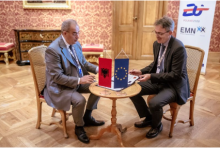
Albania has officially joined the European Migration Network (EMN) as an Observer Country. An Administrative Agreement was signed on 24 June between the European Commission and the Albanian Ministry of Interior. The arrangement was concluded on the margins of a conference co-organised by EMN Poland and establishes formal cooperation between the two parties within the EMN framework.
Read more
Main Theme: Cross-sectional, Asylum, Migration
Keywords: European Migration Network, observer country, Albania
World Refugee Day is celebrated every year on 20 June to recognise the situation of refugees worldwide. The day aims to raise public awareness and foster understanding of the challenges faced by displaced people. Various testimonies, events, and initiatives take place internationally and in Belgium. This year, World Refugee Day focuses on solidarity with refugees.