Experts meet at EMN Poland Presidency Conference to discuss irregular migration
On 24 June 2025, EMN Belgium participated in the Polish Presidency Conference on countering irregular migration. The discussions examined this phenomenon from three perspectives: strengthening the EU’s external borders to prevent irregular entries, combating migrant smuggling to dismantle criminal networks, and addressing the root causes of irregular migration and providing safe and legal alternatives.
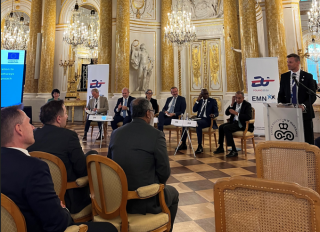
As one of the last events of the Polish Presidency of the Council of the EU, EMN Poland and the Polish Office for Foreigners, in cooperation with the Polish Ministry of Interior and Administration, hosted this conference to focus on three key areas of shared interest, which structured the discussions:
- Strengthening the management of the EU’s external borders to prevent irregular migration;
- Preventing and responding to migrant smuggling within the framework of the Global Alliance to Counter Migrant Smuggling;
- Addressing the root causes of irregular migration to the EU, promoting legal pathways and reinforcing the external dimension of migration through the Team Europe approach.
The following key takeaways can be highlighted from the discussions:
- Experts highlighted that irregular migration is increasingly being instrumentalised by certain foreign actors, who may actively support or direct migratory movements across EU borders, as observed in the context of the Belarus–Poland border. This evolving context presents growing logistical and financial challenges for border authorities. At the same time, the EU and its Member States are placing greater emphasis on economy-driven migration policies, promoting legal pathways and circular migration as part of a broader approach to international mobility and partnerships.
- Smuggling networks are highly organised, decentralised, and technologically adaptive. They operate across multiple borders and adjust rapidly to enforcement measures, making it extremely difficult to effectively prevent irregular entries. By contrast, the EU’s countermeasures are often slower and less coordinated, particularly in terms of information exchange and legal cooperation. Panelists therefore called for improved data-sharing among Member States and more systematic use of existing EU platforms that support operational cooperation.
- Better data exchange and access to information were highlighted by participants as crucial for more effective migration management. Participants noted that accurate and timely data are essential for both situational awareness — understanding what is happening on the ground — and predictive intelligence to support long-term planning. Tools such as Frontex and inter-agency coordination mechanisms can facilitate this exchange, while migration liaison officers can provide in-country insights and help initiate structured migration dialogues.
- Participants highlighted that the fight against irregular migration and smuggling requires more effective returns as well as the promotion of alternative legal pathways. While return policies and readmission schemes can act as a deterrent to further irregular migration, the development of safe legal pathways contributes to economic growth and helps address demographic challenges in receiving countries. However, representatives of origin countries emphasised that such legal pathways must prioritise circular migration to prevent brain drain.
- Addressing the root causes of irregular migration was identified by participants as a shared priority among origin, transit, and destination countries. Investment in capacity-building for partner countries was highlighted as necessary to achieve this common objective. Within countries of origin, the fight against irregular migration begins with local and territorial development, industrialisation, and the stimulation of youth entrepreneurship.
- Collaboration with third countries, between EU Member States, and among EU agencies was highlighted by participants as key to building sustainable migration systems. A consistent theme across all panels was the fragmented nature of current migration and border responses — whether at the border, in smuggling enforcement, or in cooperation with third countries. Participants stressed the need for a coordinated, EU-wide approach that connects border management, law enforcement, legal migration, and development cooperation, moving beyond siloed or purely reactive measures.
For further information and photos, please visit this page.