
Publication date:
The Council of Ministers approved, at second reading, two draft bills aimed at implementing the European Pact on Migration and Asylum in Belgian law. The texts were adopted with a view to their submission to the Chamber of Representatives of Belgium under an urgent procedure. The first draft bill aims to apply or transpose eight legislative instruments of the Pact into Belgian law, while the second concerns procedures before the Council for Alien Law Litigation.
Read more
Main theme: Cross-sectional, Asylum, Migration
Keywords: New Pact on Migration and Asylum, implementation, transposition, Belgian law
Publication date:
According to the Latest Asylum Trends 2025 published by the European Union Agency for Asylum (EUAA), EU+ countries received approximately 822.000 applications for international protection in 2025, representing a 19 % decrease compared to 2024. Despite the overall decline, demand for protection remained significant in some groups and countries.
Read more
Publication date:
The Belgian Constitutional Court has temporarily suspended legislative measures introduced in 2025 that tightened rules on material reception conditions for asylum seekers and family reunification for beneficiaries of subsidiary protection. The suspensions concern two separate laws, and the Court has referred several preliminary questions to the Court of Justice of the European Union (CJEU) to clarify their compatibility with EU law.
Read more

Publication date:
Four years after Russia launched its full-scale invasion of Ukraine on 24 February 2022, Belgium has granted more than 101.500 temporary protection certificates to people fleeing the conflict. Today, around 70.600 of these displaced Ukrainians remain in the country. While the temporary protection scheme has been extended until March 2027, uncertainty remains over what will happen afterwards, raising questions for both the authorities and Ukrainian beneficiaries.
Read more
Main theme: Temporary protection
Keywords: beneficiary of temporary protection, accommodation, transition, legal status, voluntary return, reintegration
Publication date:
The medical office run by Médecins du Monde within the Humanitarian Hub in Brussels will cease its activities on 31 March 2026. The closure follows the recent shutdown of the Athena Medical Centre. According to the organisation, this will further reduce access to primary healthcare for vulnerable groups in the capital. Médecins du Monde has warned of likely consequences for emergency services and for people with limited access to care.
Read more
Main theme: Vulnerable groups, Asylum, Migration
Keywords: Humanitarian Hub, Brussels, access to healthcare, vulnerable persons
Publication date:
Refugee Walk 2026 is an annual fundraising walking event organised by Vluchtelingenwerk Vlaanderen. Thousands of participants will walk either 20 km or 40 km on 4 October, choosing to join the central event in Brussels or to follow a self-selected route elsewhere. Walkers participate individually or with friends, colleagues, or organisations, combining physical activity with a visible show of solidarity for refugees.
Read more
Main theme: Asylum
Keywords: Refugee Walk, solidarity, refugee
Publication date:
On 19 February 2026, EMN Belgium attended a Mutual Learning Seminar organised by ECRE (European Council on Refugees and Exiles) within the framework of the INNOVATE project, supported by EU funding under the Horizon 2020 programme.Held in Brussels, the seminar brought together experts, civil society representatives and policymakers to assess the state of preparedness across EU Member States for transitioning out of temporary protection under the Temporary Protection Directive, currently extended until March 2027.
Read more
Main theme: Temporary protection
Keywords: beneficiary of temporary protection, transition, legal status, voluntary return, reintegration
Publication date:
The Klarafestival 2026 in Brussels brings together audiences, musicians, and participants from diverse backgrounds around the theme “Where is Home?”. The festival combines classical music concerts with additional activities such as conferences and discussions. It also engages in social initiatives, giving young talents a platform and reaching communities that do not usually experience live classical music. In 2026, particular attention is given to refugees, highlighting the importance of having a safe home and a sense of belonging.
Read more
Main theme: International Protection
Keywords: Klarafestival, UNHCR, refugee, home, safety
Publication date:
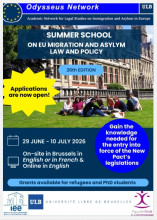
The Summer School in Brussels brings together around 100 participants, including students, academics, and professionals from EU Member States and EU institutions, as well as refugee-students supported by the RefYOUgees initiative. It combines a series of courses on EU Migration and Asylum Law with debates on recent policy developments. Participants also attend seminars presenting PhD research projects and discuss complex legal and policy issues. The programme provides opportunities for interaction and networking among students, academics, practitioners, and refugee participants.
Read more
Main theme: Cross-sectional, Asylum, Migration
Keywords: Odysseus Network, summer school
Publication date:
Fedasil has released its management plan for 2025–2030. Approved in December 2025 and submitted by Director General Pieter Spinnewijn to the Minister for Asylum and Migration, the plan sets out the Agency’s priorities, including restoring the core functioning of the reception system, strengthening its capacity to respond to fluctuations in the number of applicants to be accommodated, and improving the quality, resilience, and effectiveness of services.
Read more
Main theme: Reception
Keywords: Fedasil, management plan, reception policy

Publication date:
The Council of Europe’s Division on Migration and Refugees published a Frequently Asked Questions document on 12 February 2026, explaining how the European Convention on Human Rights (ECHR) applies to migration issues. It clarifies which rights are relevant to non-nationals, how national authorities retain discretion over entry and stay, and the limited circumstances under which the European Court of Human Rights (ECHR) may intervene. The document also provides data on immigration-related cases processed over the past decade.
Read more
Publication date:
On 9 February 2026, the Minerva think tank published a report assessing the economic and demographic impacts of current asylum and migration policies in Belgium, while also considering comparative cases in other European countries. It examines how policy choices in this field interact with labour market needs, demographic trends and public finances, and explores potential medium- to long-term effects associated with different policy approaches. The publication contributes to the broader policy debate by presenting available data and modelling selected scenarios.
Read more
Main theme: Cross-sectional, Asylum, Migration
Keywords: asylum policy, migration policy, labour market, demography, population ageing, welfare
Publication date:
The European Parliament has approved new EU asylum rules to enable faster processing of asylum requests. The reform establishes a common list of safe countries of origin while allowing Member States to maintain or designate additional safe countries at national level. It also clarifies the conditions under which Member States can apply the safe third country concept. While the legislation has now passed Parliament, it still needs to be formally adopted by the Council before entering into force.
Read more
Main theme: International Protection
Keywords: list of safe countries of origin, safe third country, safe country of origin
Publication date:
On 4 February 2026, Human Rights Watch published World Report 2026, its annual review of human rights worldwide. In a chapter on the European Union, the report highlights concerns that EU policies and Member State actions may undermine the rights of migrants, refugees, and asylum seekers. It notes, inter alia, restrictions on access to asylum, measures aimed at increasing removals, and the transfer of responsibility to third countries. The report also draws attention to human rights issues at EU borders and deaths at sea.
Read more
Main theme: Cross-sectional, Asylum, Migration
Keywords: asylum policy, migration policy, return regulation, human rights, rights violations
Publication date:
On 29 January 2026, the European Commission presented the first European Asylum and Migration Management Strategy, setting out the Union’s objectives on asylum and migration for the next five years. The Strategy identifies three overarching objectives: preventing irregular migration and disrupting smuggling networks; protecting people fleeing conflict and persecution while preventing abuse of the asylum system; and attracting talent to support the EU economy. It also outlines a set of priorities to guide EU action in the coming years.
Read more

Publication date:
In 2025, Belgium received 34.439 applications for international protection, a decline compared with 2024. The Office of the Commissioner General for Refugees and Stateless Persons (CGRS) took decisions on 31.457 people, with a protection rate falling to its lowest level in over a decade. Key factors behind this trend include the suspension of the processing of Syrian cases in the first ten months of 2025 and prioritisation of applications from individuals already protected in other EU Member States.
Read more
Main theme: International Protection
Keywords: application for international protection, asylum decisions, protection rate

Publication date:
The Office of the Commissioner General for Refugees and Stateless Persons (CGVS) announced on 15 January 2026 that it is temporarily suspending the processing of applications for international protection from Iranian nationals. The CGVS stated that, given the current situation in Iran and the difficulty in obtaining sufficiently reliable and up-to-date information, it is currently unable to assess the need for protection accurately.
Read more
Main theme: International Protection
Keywords: application for international protection, Iran, suspension, asylum decisions

Publication date:
On 8 January 2026, the Resettlement Coalition issued a joint statement expressing concern over the European Union’s newly adopted Union Resettlement and Humanitarian Admission Plan (URP) for 2026–2027. While welcoming the plan’s adoption as a step towards embedding resettlement in EU migration policy, the coalition highlighted that the number of pledges is dramatically lower than previous commitments and that the eligibility criteria are narrow. The statement calls on EU Member States to increase their contributions and ensure that protection needs remain central to resettlement efforts.
Read more
Main theme: International Protection
Keywords: Union Resettlement and Humanitarian Admission Plan, EU resettlement framework, pledge, eligibility
Publication date:
On 1 January 2026, Cyprus assumes the Presidency of the Council of the European Union for six months. The Presidency’s programme includes the implementation of the EU Pact on Migration and Asylum, the efficiency of asylum and return systems, and cooperation with third countries. International organisations have issued recommendations to the Cyprus Presidency on migration and asylum.
Read more
Main theme: Cross-sectional, Asylum, Migration
Keywords: Cyprus, presidency, Council of the European Union

Publication date:
As 2025 comes to a close, the EMN Belgium team warmly thanks you for your continued interest in and engagement with the work of the European Migration Network. Your active participation has been essential in supporting exchanges and fostering a shared understanding of key developments and challenges in asylum and migration.
Read more
Main theme: Cross-sectional, Asylum, Migration
Keywords: holiday season greetings, EMN Belgium, New Year wishes

Publication date:
The Belgian Council of Ministers has taken note of a strategic vision for the reorganisation and centralisation of the federal administrative landscape. The plan foresees the regrouping of asylum and migration services under a dedicated Federal Public Service (FPS) Migration. The Council of Ministers has approved a timeline for the reorganisation and centralisation and has tasked the Minister for Public Administration with overseeing its implementation.
Read more
Main theme: Cross-sectional, Asylum, Migration
Keywords: federal administration, Belgium, Federal Public Service Migration
Publication date:
In a judgment delivered in Case C-184/24 (Sidi Bouzid), the Court of Justice of the European Union has clarified the limits of sanctions that may be imposed on applicants for international protection who refuse to be transferred to another accommodation centre. The Court found that such a refusal cannot justify the withdrawal of all material reception conditions. While Member States may impose sanctions for serious breaches of reception rules, these must remain proportionate and respect the applicant’s dignity.
Read more
Main theme: Reception
Keywords: reception centre, transfer, refusal, sanction, material reception condition, withdrawal
Publication date:
The Council of the European Union has formally adopted the Annual Solidarity Pool for 2026 under the EU Pact on Migration and Asylum. The mechanism aims to support Member States under migratory pressure through relocation of asylum seekers, financial contributions and alternative solidarity measures. Belgium has committed around €12.9 million to the pool.
Read more
Main theme: Cross-sectional, Asylum, Migration
Keywords: solidarity pool, New Pact on Migration and Asylum, relocation, financial contribution

Publication date:
On 15 and 16 December 2025, EMN Belgium organised a conference in Brussels bringing together stakeholders from Belgium, EMN Member and Observer Countries, as well as European and international organisations. The event provided a forum to examine reception and support for applicants for international protection other than in-kind from legal, policy, and operational perspectives, exploring how these forms of support are organised, implemented, and linked to broader reception systems.
Read more
Main theme: Reception
Keywords: material reception condition, reception modality, housing, community-based approach, cash-based approach, financial allowance
Publication date:
EU Home Affairs Ministers have reached a political agreement on the 2026 solidarity pool, a central component of the Pact on Migration and Asylum. The deal sets binding targets of 21.000 relocations or €420 million in contributions, aimed at supporting Member States under migratory pressure. Greece, Cyprus, Italy and Spain are identified as beneficiaries once the Pact becomes applicable in June 2026. The agreement marks a step forward for the solidarity dimension of the Pact, although its practical impact will depend on future implementation.