EMN Belgium gathers experts to explore reception and support of applicants for international protection other than in-kind
On 15 and 16 December 2025, EMN Belgium organised a conference in Brussels bringing together stakeholders from Belgium, EMN Member and Observer Countries, as well as European and international organisations. The event provided a forum to examine reception and support for applicants for international protection other than in-kind from legal, policy, and operational perspectives, exploring how these forms of support are organised, implemented, and linked to broader reception systems.
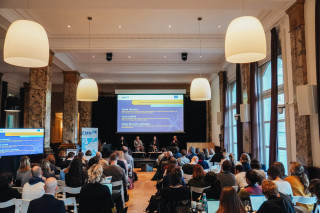
The conference brought together a broad range of stakeholders, including representatives from the Belgian Cabinet of the Minister for Asylum and Migration, the Belgian reception agency Fedasil, reception agencies from several EMN Member and Observer Countries, EU institutions, international organisations, local authorities, civil society organisations and academic institutions.
The conference mainly took place in plenary sessions. Discussions on the first day focused on the EU legal framework and national policy contexts, as well as pressures on reception systems and the situation of applicants living outside reception facilities. Participants discussed how authorities in different EMN Member and Observer Countries organise follow-up and ensure access to essential services for applicants not accommodated in reception centres. The second day examined whether and how community-based approaches could serve as complementary options for applicants who voluntarily choose not to reside in collective reception centres. Participants also explored the links between housing arrangements and different forms of financial support.
The discussions allowed participants to identify several key messages and lessons, including:
- EU legal framework and reception and support other than in-kind: Discussions noted that reception and support of applicants for international protection other than in-kind is provided for under the EU Reception Conditions Directive. The Directive defines material reception conditions as including housing, food, clothing and personal hygiene products provided in kind, as financial allowances, in vouchers, or as a combination thereof, as well as a daily expenses allowance. While the Directive allows flexibility in the choice of reception modalities, participants emphasised that it is always the responsibility of the authorities to ensure that all applicants for international protection have access to reception conditions that provide an adequate standard of living, in line with EU law.
- Applicants living outside reception facilities: Across EMN Member and Observer Countries, applicants for international protection reside outside collective reception facilities for various reasons, including limited reception capacity, family or personal circumstances, including staying near informal support networks, and practical considerations related to work, education, or daily life. Discussions highlighted the diversity of situations associated with living outside reception centres, as well as a range of related challenges, particularly in terms of housing stability, access to services, and continuity of support. Participants emphasised the importance of maintaining regular contact with applicants living outside reception facilities and of implementing appropriate follow-up mechanisms. Local actors and civil society organisations underlined in this regard their role and the substantial demands placed on them, as they often support applicants in navigating daily life outside collective reception structures.
- Community-based approaches: The conference examined community-based approaches as one form of reception and support other than in-kind. Discussions focused on the conditions under which such approaches are implemented, including the importance of a clear and consistent political narrative and strong engagement with local authorities and community actors. Decentralised, community-rooted models allow reception systems to adapt to local realities and leverage existing municipal and community networks to connect applicants with essential services. Participants also emphasised the need for clear frameworks, safeguards, and monitoring arrangements to ensure compliance with reception standards.
- Financial allowances within reception and support systems: Financial allowances were discussed as one modality within reception and support systems other than in-kind. Participants emphasised that their effectiveness depends on the extent to which they ensure applicants’ access to material reception conditions in practice. They noted the importance of providing sufficient support, implementing appropriate monitoring arrangements, and considering which applicant profiles are best suited to receive financial allowances, including attention to the needs of vulnerable groups. Financial allowances were generally discussed as part of broader reception frameworks rather than as standalone measures, and were seen as a complementary tool that can be scaled up in response to contingencies or crises and combined with other forms of support.
The conference also featured parallel roundtables focusing on access to information, access to healthcare, and access to an address for applicants not provided with housing in kind. These sessions focused on practical challenges and operational experiences related to access to services and administrative procedures.
The conference report will be published on the conference webpage, where presentations and photos from the two days are already available.
EMN Belgium thanks all speakers and participants for their contributions to the conference. The exchange of perspectives and experiences supported further reflection on challenges and approaches related to reception and support of applicants for international protection other than in-kind.