EU Parliament backs EU Talent Pool to facilitate international recruitment for in-demand occupations
The European Parliament has endorsed the creation of an EU Talent Pool, a digital platform designed to match job vacancies in participating Member States with job seekers from third countries. The initiative aims to support recruitment in sectors facing labour shortages while remaining subject to national immigration procedures and voluntary participation by Member States. While supporters highlight its potential to strengthen legal pathways for labour migration, trade unions have raised concerns about worker protection and safeguards. The proposal still requires formal adoption by the Council before entering into force.
Hoofdthema: Economic migration
Trefwoorden: EU Talent Pool, adoption, European Parliament
Flanders granted around 21.460 work permits to non-EU nationals in 2025, the highest level in recent years. Seasonal work and medium- to high-skilled positions accounted for a large share of the permits. New rules introduced in January 2026 give priority to domestic and EU labour before non-EU recruitment. Stakeholders, including employer organisations and political parties, have expressed differing perspectives on these developments.
Hoofdthema: Data & Statistics, Economic migration
Trefwoorden: Flanders, work permit, single permit, third-country nationals, seasonal work, shortage occupation
The documents set out key elements of the European Commission’s approach to managing international mobility to the EU. The EU Visa Strategy aims to strengthen the Union’s security and integrity through enhanced visa procedures, modernise the processing and management of visas, and support the EU’s economy and competitiveness by facilitating legitimate travel. Complementing this, the Recommendation on Attracting Talent for Innovation provides guidance to Member States on attracting, admitting, and retaining international students, researchers, highly skilled workers, and innovative entrepreneurs.
Hoofdthema: Economic migration, Study § Training, Borders & Visa
Trefwoorden: visa policy, visa strategy, talent attraction, talent retention
On 18 November, the Council of the European Union and the European Parliament reached an agreement on the creation of a platform designed to facilitate the recruitment of non-European workers. The “EU Talent Pool” will connect employers established in the EU with non-EU jobseekers in sectors where Member States face labour shortages. Participation in the Talent Pool will be voluntary for Member States, and the platform will remain free of charge for both jobseekers and employers.
Hoofdthema: Economic migration
Trefwoorden: EU Talent Pool, foreign workers, labour shortages, competitiveness

The Flemish government has decided that third-country workers – from outside the EU, Iceland, Liechtenstein, Norway and Switzerland – will follow a mandatory tailored integration trajectory from 2027. The initiative, proposed by Minister Hilde Crevits, will be delivered digitally and can be started in the country of origin or within six months of arrival in Flanders. The programme provides essential information on work, rights and responsibilities, and Flemish norms and values. Certain temporary or seasonal workers, students, and holiday-work participants are excluded.
Hoofdthema: Integration, Economic migration
Trefwoorden: migrant worker, self-employed, integration programme, digital learning

Myria, the Federal Migration Centre, has published a thematic report on economic migration, free movement and students as part of its annual report "Migration in figures and rights 2025". The publication explains trends in labour migration and study-related mobility. It shows that labour migration from outside the EU has slightly decreased, the share of third-country nationals among temporary postings has continued to grow, and student numbers are increasing.
Hoofdthema: Economic migration, Study § Training
Trefwoorden: Myria, annual report, labour migration, student migration, temporary posting
Nearly one in eight self-employed workers in Belgium do not hold Belgian nationality. This proportion rises to more than four in ten in the Brussels-Capital Region. An analysis of recent data from the National Institute for Social Security of the Self-Employed (INASTI) by the social insurance fund Acerta highlights these figures. The study also reveals differences in age, sector activity, and income between Belgian and non-Belgian self-employed individuals.
Hoofdthema: Integration, Data & Statistics, Economic migration
Trefwoorden: self-employed, Belgian, non-Belgian
The European Commission has developed a new interactive tool to map labour migration pathways across the 27 EU Member States. It helps to visualise the 290 pathways that were active at the time of the research and updated to February 2024.
Hoofdthema: Economic migration
Trefwoorden: labour migration, legal pathway, foreign job seeker
In a recent judgment, the Court of Justice of the European Union stated that a Member State cannot exclude from the benefit of family allowances a foreign worker whose children, born in a third country, cannot prove that they have entered its territory lawfully.
Hoofdthema: Economic migration
Trefwoorden: migrant worker, equal treatment, social security, family benefits, minor
Myria has published the fourth thematic section of its 2024 annual report. In this section, entitled « Economic migration, free movement and students » Myria notes that more third-country nationals were posted to Belgium in 2023 than in 2022. Posted workers from third countries are more vulnerable to exploitation than EU-based posted workers. Therefore, they urgently need increased legal protection, according to Myria.
Hoofdthema: Economic migration
Trefwoorden: migrant worker, posted worker, exploitation
Op 19 september 2024 presenteerde EMN België de bevindingen voor van zijn nationale bijdrage aan de komende EMN Studie over de Illegale tewerkstelling van onderdanen van derde landen (2017-2022). Daarbij werd de vergelijking gemaakt met de nationale bijdragen van EMN Oostenrijk en EMN Italië.
The Walloon administration announces that new regulations come into force on 1 September 2024 regarding salaried economic migration for foreign workers in Wallonia. The system remains largely unchanged in its principles, still falling within the broader framework of the Single Permit for work and residence authorization for foreign workers. However, a new decree of the Walloon Government organizes new features and modifications.
Hoofdthema: Economic migration
Trefwoorden: foreign workers, employer, single permit, EU blue card
On 13 June 2024, the Council of the European Union agreed its position on the proposal for an EU Talent Pool to facilitate the recruitment of talent from third countries who live outside the EU, to make the EU labour market more competitive and to tackle shortages on the European labour market.
Hoofdthema: Economic migration
Trefwoorden: EU Talent Pool, shortage occupation, talent mobility
Op vrijdag 12 april 2024 heeft de Raad van de Europese Unie de herziene Richtlijn betreffende de Gecombineerde Vergunning goedgekeurd, waarin de procedure wordt vastgesteld voor het verkrijgen van een gecombineerde vergunning om in de EU te werken en te verblijven met een gemeenschappelijk pakket rechten voor werknemers uit derde landen. De herziening voorziet in een verkorte aanvraagprocedure en beoogt de rechten van werknemers uit derde landen te versterken door verandering van werkgever en een beperkte periode van werkloosheid toe te staan.
Hoofdthema: Economische migratie
Trefwoorden: Richtlijn Gecombineerde Vergunning, herziening
As labour and skills shortages have been increasing and are expected to continue rising over the coming decades in all EU Member States, the European Commission published an action plan setting out key measures that the EU, Member States and social partners should take in the short to medium term to address this challenge.
Hoofdthema: Economic migration
Trefwoorden: labour shortage, skills shortage, social partner, labour market integration, skills development, intra EU mobility, talent partnership
Vandaag heeft het Parlement van het Brussels Hoofdstedelijk Gewest in plenaire zitting een ordonnantie betreffende economische migratie aangenomen. Het doel is de huidige teksten te moderniseren, coherenter te maken en te vereenvoudigen, om zo beter te kunnen inspelen op de tekorten aan arbeidskrachten die op de arbeidsmarkt worden vastgesteld.
Hoofdthema: Economische migratie
Trefwoorden: tekort aan arbeidskrachten, arbeidstekort, Brussels, buitenlandse werknemers
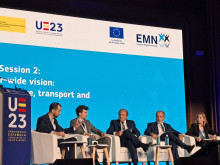
Het Europees Migratienetwerk (EMN) hield een tweedaagse conferentie met de titel "Shaping the future of EU legal migration: waar zijn we en waar willen we naartoe?". Het evenement maakte deel uit van het huidige Spaanse voorzitterschap van de Raad van de EU, met de nadruk op legale migratiestrategieën om het benodigde talent en de vaardigheden uit het buitenland aan te trekken.
Hoofdthema: Economische migratie
Trefwoorden: talent partnership, mobiliteit van talenten, erkenning van vaardigheden, EU Talent Pool, tekort aan arbeidskrachten
The Commission is today presenting a Skills and Talent Mobility package to make the EU more attractive to talent from outside the EU and to facilitate mobility within it. Today's measures include a new EU Talent Pool to match employers in the EU with jobseekers in third countries, as well as measures to promote the recognition of qualifications and learner's mobility.
Hoofdthema: Economic migration
Trefwoorden: EU Talent Pool, talent partnership, skills recognition, mobility
De multidisciplinaire woordenlijst van het Europees Migratienetwerk (EMN) heeft ongeveer 500 termen en concepten met betrekking tot asiel en migratie. Laten we ons vandaag concentreren op de term "tekort aan arbeidskrachten" om er zeker van te zijn dat we de term gemeenschappelijk begrijpen en gebruiken!
Hoofdthema: Economische migratie
Trefwoorden: tekort aan arbeidskrachten, toegang tot de arbeidsmarkt
The 2023 Innovation Awards were awarded at the IOM Global Chiefs of Missions Meeting (GCOMM) in Istanbul on 25 October 2023. In the category "Regular Pathways", Displaced Talent for Europe (DT4E), which facilitates skilled migration for displaced talent to respond to labour market shortages, was acknowledged as the changemaker.
Hoofdthema: Economic migration
Trefwoorden: regular pathway, skilled migrants, displaced person, labour market shortage
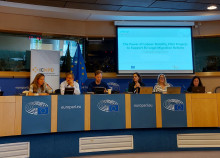
Het Europees Migratienetwerk (EMN) België was vandaag aanwezig in het Europees Parlement voor een presentatie over "De kracht van pilotprojecten voor arbeidsmobiliteit ter ondersteuning van de hervorming van het EU-legale migratiebeleid", georganiseerd door het International Centre for Migration Policy Development (ICMPD).
Hoofdthema: Economische migratie
Trefwoorden: arbeidsmobiliteit, pilotproject, Migration Partnership Facility
Een nieuwe lijst met middengeschoolde knelpuntberoepen die openstaan voor migratie treedt op 1 september 2023 in werking. De nieuwe lijst werd aangepast aan de huidige economische realiteit en arbeidsmarktsituatie - ze bevat nu 29 functies.
Hoofdthema: Economische migratie
Trefwoorden: knelpuntberoep, arbeidsmarkt

De Minister-President van Wallonië, Elio Di Rupo, heeft een brief geschreven aan Premier Alexander De Croo om te pleiten voor de regularisatie van immigranten zonder geldige verblijfsstatus die geschikt zijn om te werken in sectoren waar een tekort aan arbeidskrachten heerst, zoals gemeld door L'Echo.
Hoofdthema: Economische migratie
Trefwoorden: tekort aan arbeidskrachten, knelpuntberoep, regularisatie, single permit
Myria has published the fourth thematic section of its 2023 annual report. This section entitled "Economic migration, free movement en students" reports that 8.098 long-stay visas were granted for professional reasons to third-country nationals in 2022 (46% more than in 2021) and 19.721 single permits were issued to third-country nationals in 2022 (75% more than in 2021).
Hoofdthema: Economic migration
Trefwoorden: long-stay visa, single permit, posted worker, student
The Fair Recruitment Initiative (FRI) was launched in 2014 as part of the International Labour Organization (ILO) Director General’s call for a Fair Migration Agenda. Since its launch, the FRI has been critical to ILO’s work in the area of national and international recruitment of workers.