On 2 May 2024, President von der Leyen was with Cypriot President Christodoulides in Beirut to announce a financial package of EUR 1 billion for Lebanon to contribute to the country's socio-economic stability and to migration management. The deal has already received criticism from various quarters.
Read more
Main Theme: External Dimension
Keywords: partnership, irregular migration, financial package, migration management
On 2 May 2024, the Chamber of Representatives adopted in plenary session the draft law relating to the competencies of the members of the European Border and Coast Guard Agency on the national territory. The law inter alia defines how Frontex members will support the Federal Police in the field of border controls and forced return of foreigners.
Read more
Main Theme: Borders & Visa
Keywords: European Border and Coast Guard, Frontex, border control, forced return, escort
On 2 May 2024, the Chamber of Representatives adopted in plenary session the draft law for a proactive return policy. This law inter alia introduces the obligation for the foreigner to cooperate in the return process and it expands the pool of return escorts. The law also enshrines the principle according to which minor children aren't retained in closed centres.
Read more
Main Theme: Return & Readmission
Keywords: proactive return policy

The Belgian Presidency of the EU Council organised a Ministerial Conference to work towards a common understanding of the main stages of the implementation of the Pact. Particular attention was paid to the development of common and national implementation plans, the role of EU agencies and key stakeholders, as well as good practices from EU countries.
Read more
Main Theme: Cross-sectional
Keywords: New Pact on Migration and Asylum, implementation, operationalisation
The Council of Ministers approves the public procurement for new closed centers in Jabbeke and Jumet

On 26 April 2024, the Council of Ministers approved, upon proposal by the Secretary of State for Asylum and Migration Nicole de Moor and the Secretary of State in charge of the Buildings Administration Mathieu Michel, the public procurement for new closed centers in Jabbeke and Jumet.
Read more
Main Theme: Return & Readmission
Keywords: closed centre, forced return, State Secretary for Asylum Policy and Migration
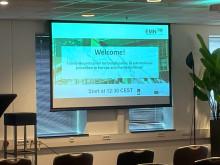
On 24 April 2024, EMN Netherlands, in cooperation with EMN Belgium, organised a conference on family reunification with beneficiaries of international protection. The conference highlighted the EMN Inform on “Family Reunification for Beneficiaries of International Protection”, which was elaborated in light of the 20th anniversary of the Family Reunification Directive.
Read more
Main Theme: Family reunification
Keywords: Family Reunification Directive, beneficiary of international protection, family tie, documentary proof, children
On 23 April 2024, the European Parliament voted in favor of an amended Directive concerning trafficking in human beings. The new text broadens the EU’s actions against human trafficking beyond labour and sexual exploitation, and also criminalises new forms of exploitation like forced marriage, illicit adoption, and the exploitation of surrogacy at the EU level.
Read more

Under the framework of the Belgian Presidency of the Council of the European Union, EMN Belgium, together with its partners, organise a high-level conference on 25-26 June 2024 to discuss the operationalisation and implementation of the New Pact on Migration and Asylum. If you wish to join us in Brussels or online, make sure to register now!
Read more
Main Theme: Cross-sectional
Keywords: Belgian Presidency, New Pact on Migration and Asylum

On the proposal of Minister of Foreign Affairs Hadja Lahbib and Secretary of State for Asylum and Migration Nicole de Moor, the Council of Ministers approved a draft royal decree establishing the list of safe countries of origin, now including Moldova.
Read more
Main Theme: International Protection
Keywords: list of safe countries of origin, moldova

During its annual policy event, the Belgian Contact Point of the European Migration Network (EMN) invited experts in the field of asylum and migration in Belgium to reflect on developments in 2023 and prospects for 2024. Subgroups examined in more detail measures in response to the reception crisis, the new right of residence for stateless persons, information campaigns in third countries, one-stop desk models for information provision, ongoing challenges and projects in the CGRS, Belgium’s talent mobility projects and emerging trends in the field of labour migration.
Read more
Main Theme: Cross-sectional
Keywords: annual EMN policy event
On 16 April 2024, the Commission published its 2024 State of Schengen report. The report elaborates on major legislative and policy developments in the area of Schengen from the past year, including the Pact on Migration and Asylum. It also reflects on challenges and sheds light on future priorities for the EU in the field of Schengen.
Read more
Main Theme: Borders & Visa
Keywords: Schengen area, State of Schengen, Schengen governance, internal border, external border

A large delegation from the federal government, accompanied by senior police officers and senior administration officials, is leading a mission to Morocco. The fight against illegal immigration and the return policy are among the priority issues discussed with the Moroccan authorities.
Read more
Main Theme: Return & Readmission
Keywords: irregularly staying third-country national, Morocco, prison, identification
On Friday 12 April 2024, the Council of the European Union adopted the revised Single Permit Directive which defines the procedure for obtaining a single permit to work and reside in the EU with a common set of rights for third-country workers. The revision provides for a shortened application procedure and aims to strengthen the rights of third-country workers by allowing a change of employer and a limited period of unemployment.
Read more
Main Theme: Economic migration
Keywords: single permit directive, recast
At the request of the European Ombudsman, an inquiry was launched into the European Commission's approach to ensuring respect for human rights in the EU-Tunisia Memorandum of Understanding (MoU) “on a strategic and global partnership”. This inquiry follows concerns about the absence of a prior human rights impact assessment in the context of the Memorandum.
Read more
Main Theme: External Dimension
Keywords: memorandum of understanding, Tunisia, human rights
On 10 April 2024, the European Parliament narrowly approved ten legislative texts to reform the European migration and asylum policy. The so-called New Pact on Migration and Asylum now only needs the final green light from Member States, which is expected at the end of the month.
Read more
Main Theme: Cross-sectional
Keywords: New Pact on Migration and Asylum
The Flemish Red Cross confirmed that the emergency village built in Mechelen in May 2022 for Ukrainians will close its doors in a few months. The rental contracts expire at the end of June 2024 and the Flemish Red Cross wants to help the 319 people still staying there find sustainable housing by then.
Read more
Main Theme: Temporary protection
Keywords: temporary protection, Ukraine, emergency village
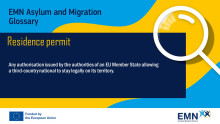
The European Migration Network (EMN) Glossary is an essential resource, which offers an EU-wide multidisciplinary vocabulary of approximately 500 terms and concepts related to asylum and migration. Let's focus today on the term "residence permit" to make sure we have a common understanding and use of the term!
Read more
Main Theme: Migration
Keywords: legal migration, residence permit
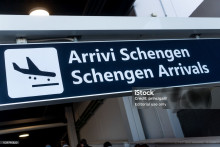
On 31 March 2024, Bulgaria and Romania become Schengen members: the Schengen rules will apply in both Member States including on issuing Schengen visas and controls at the internal air and sea borders will be lifted. Discussions on a date for a possible lifting of the checks on persons at internal land borders will continue in 2024.
Read more
Main Theme: Borders & Visa
Keywords: Schengen, Schengen acquis, Bulgaria, Romania
On a proposal from Interior Minister Annelies Verlinden, the Council of Ministers approved a preliminary draft law defining the powers that members of the European Border and Coast Guard would have on national territory during official missions.
Read more
Main Theme: Return & Readmission
Keywords: European Border and Coast Guard, Frontex, border control, forced return, escort
The House of Representatives approved a draft law creating a prevention mechanism to safeguard the rights of people detained in prisons, closed centres and police stations. The mechanism will be overseen by the Federal Institute for Human Rights, in conjunction with the Central Prison Monitoring Council, the Federal Migration Centre Myria, and 'Committee P'.
Read more
Main Theme: Cross-sectional
Keywords: prison, closed centre, monitoring, torture
On 28 March 2024, the House of Representatives, during the plenary session, approved by a majority the ETIAS law which establishes the Belgian ETIAS National Unit and defines its organisation and functioning. It will enforce the ETIAS (European Travel Information and Authorisation System) regulation adopted by the European Union in 2018.
Read more
Main Theme: Borders & Visa
Keywords: ETIAS, European Travel Information and Authorisation System
In 2023, Belgium registered 8,8% fewer first-time asylum applicants than in 2022, that is to say, 29.260 in 2023 compared to 32.100 in 2022. On the contrary, the number of first-time asylum applicants registered in the whole EU in 2023 reached 1.048.880, which represents an increase of 20.1 % compared to 2022.
Read more
Main Theme: Data & Statistics
Keywords: first-time asylum applicant, Eurostat
During the European Council on 21-22 March 2024, EU leaders reviewed the state of play on migration following the Communication from the Commission and reaffirmed the EU’s commitment to continue pursuing a comprehensive approach to migration as agreed in its conclusions of December 2023.
Read more
Main Theme: Cross-sectional
Keywords: New Pact on Migration and Asylum, Council of the European Union
As labour and skills shortages have been increasing and are expected to continue rising over the coming decades in all EU Member States, the European Commission published an action plan setting out key measures that the EU, Member States and social partners should take in the short to medium term to address this challenge.
Read more
Main Theme: Economic migration
Keywords: labour shortage, skills shortage, social partner, labour market integration, skills development, intra EU mobility, talent partnership
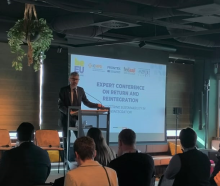
The Expert Conference on Return and Reintegration, jointly organised by Belgium’s Federal Agency for the Reception of Asylum Seekers (Fedasil), the International Centre for Migration Policy Development (ICMPD), the European Border and Coast Guard Agency (Frontex), and the Migration Policy institute Europe (MPI-E) marked a significant moment during the Belgian Presidency of the Council of the EU.