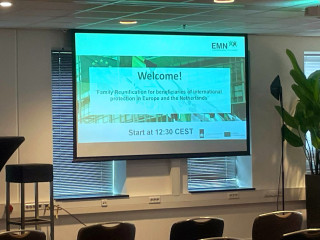
EMN Netherlands, in cooperation with EMN Belgium, organised a conference on family reunification with beneficiaries of international protection
On 24 April 2024, EMN Netherlands, in cooperation with EMN Belgium, organised a conference on family reunification with beneficiaries of international protection. The conference highlighted the EMN Inform on “Family Reunification for Beneficiaries of International Protection”, which was elaborated in light of the 20th anniversary of the Family Reunification Directive.
Jan Willem Schaper, Deputy Director-General of Strategy, Implementation Policy and Legal Affairs / Immigration and Naturalisation Service (IND) started the conference by highlighting some of the current issues in the Dutch procedure for family reunification with beneficiaries of international protection. For example, today, the waiting period for refugees to request family reunification is 17 months, while there is a backlog of 2 years for the processing of these applications.
Thereafter, five panels addressed the issue from both a national and EU perspective.
- The first panel presented the EMN Inform, showing amongst others that EMN Member States and Observer Countries differ greatly in who applies for family reunification, as well as how, where and with which documentation to apply.
- The second panel addressed different national approaches to submitting the application for family reunification for beneficiaries of international protection, and the pros and cons of each of these practices. This panel hosted speakers from Belgium, Italy and the Netherlands. For example, in the case of Belgium, the impact of the Court of Justice case ‘Afrin’ was highlighted, as well as the different ways in which a family member may submit the application (through diplomatic posts, external service providers, exceptionally via e-mail...). Italy also presented its system of “Sportello Unico per l'Immigrazione”, namely one stop desks in each province. Lastly, the Netherlands presented some of the bugs in its system, such as the long processing times, the difficulties with the collection of proof and their assessment.
- The third panel gave insight into the French practice in this matter. One of the key takeaways was that in France, family reunification of refugees applies to the couples’ unmarried children who are not over 19 years old, whereas this is usually 18 years in other Member States.
- Fourthly, there was an interactive session on the different ways in which family relations can be established. This session not only focused on official documents that can serve as proof, but also on alternative methods such as DNA-tests and interviews.
- Lastly, the fifth panel delved into recent developments regarding children within the family reunification procedure for beneficiaries of international protection, and the impact of EU case law. This session invited to for example critically assess the definition of “family”, inter alia in light of cultural differences.
For further information, please send an email to emn@ind.nl.