Human trafficking takes new forms and calls for greater international cooperation
On 2 October 2025, EMN France brought together numerous French and European stakeholders to take stock of efforts to combat human trafficking at both national and European levels. The event provided an opportunity to identify emerging forms of trafficking and to examine international cooperation tools such as Common Operational Partnerships and EMPACT-coordinated actions.
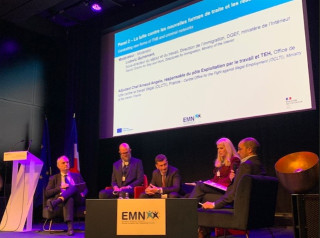
EMN Belgium attended the conference with great interest and highlighted the following key takeaways:
-
The number of identified victims of human trafficking is on the rise, with a growing proportion of third-country nationals among them. The data challenges several preconceptions: for example, a significant number of victims are men (mainly trafficked for labour exploitation), and women are also found among those suspected of trafficking offences. All stakeholders agreed that official figures fail to reflect the true scale of the phenomenon – the so-called "dark numbers".
-
Human trafficking is taking new forms. In this regard, speakers drew particular attention to: (i) labour exploitation, especially in sectors facing labour shortages; (ii) domestic servitude; (iii) sexual exploitation of victims from Latin America; (iv) criminal exploitation of minors; and (v) the shift of sexual exploitation to online platforms.
-
In response to these developments, the EU is intensifying its efforts to coordinate the fight against human trafficking. Notable recent developments include the revision of the Anti-Trafficking Directive adopted in June 2024 (to be transposed by 15 July 2026), the relaunch of the EU Civil Society Platform (CSP) against trafficking in human beings, the creation of the EU Anti-Trafficking Hub, and the strengthening of operational cooperation with Latin American countries. The 2026–2030 strategy, which will notably focus on cooperation with the private sector, is expected in October 2026.
-
Member States are also undertaking numerous initiatives, demonstrating the absolute necessity of multi-stakeholder and cross-sector cooperation. France, for example, is currently formalising its National Referral Mechanism with close involvement of associations on the ground. Greece is engaging in various partnerships through projects such as HOST (with the hospitality sector) and EMBRACE (to empower business communities to prevent labour trafficking). Serbia has established a National Platform for the Prevention of Violence Involving Children entitled “I Protect You”.
-
International cooperation is an essential tool in combating human trafficking. Such cooperation is crucial at the European level (notably through EMPACT) and with third countries – for instance, in Operation El Rais, during which Italy cooperated with countries including Egypt, Albania, Turkey, and Oman. Stakeholders underlined the growing operationalisation of cooperation tools and projects, particularly referring to Common Operational Partnerships (COP).
Many of the topics discussed during the conference are addressed in the recent EMN study on “The International Dimension of Human Trafficking”. Its findings were briefly presented during the event, highlighting key needs identified by the participating States, which include: (i) strengthening financial investigations, (ii) focusing more on the digital sphere, (iii) investing further in tackling trafficking for labour exploitation, (iv) enhancing cooperation with certain third countries, and (v) improving coordination among competent authorities.
Many thanks to EMN France for organising such an insightful conference, helping to "make the invisible visible". A full report of the discussions, along with the PowerPoint presentations, will soon be available.