Publication date: 15 October 2025
This ad hoc query maps the specific provisions concerning separated migrant children in the legislation of the Member States, including the possibility for the accompanying adult to be recognised as responsible for, or as the representative of, the accompanied separated child. It also covers the arrangements in place to preserve the relationship between the separated child and the accompanying adult, as well as the monitoring of separated children.
Read more
Main theme: Vulnerable groups
Publication Type: Ad Hoc Queries
Keywords: separated child, migrant child, care, representation, family member
Publication date: 17 April 2025
This ad hoc query explores how EMN Member and Observer Countries support legally residing migrant children (third-country nationals) in adapting to the cultural environment of primary and secondary schools. It focuses on national measures, including language support, teacher training, targeted initiatives, and the use of specific educational tools. It also examines challenges, good practices, and whether countries monitor migrant children's academic performance.
Read more
Main theme: Integration, Vulnerable groups
Publication Type: Ad Hoc Queries
Keywords: migrant child, school performance, adaptation, language learning
Publication date:
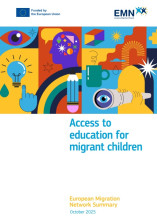
On 31 October 2025, the European Migration Network (EMN) released its latest Inform highlighting how 25 EMN Member and Observer Countries are addressing access to education for migrant children. The report shows that nearly all participating countries have adopted national measures to support linguistic, social, and emotional integration in schools. Despite persistent barriers, such as language difficulties and unequal learning outcomes, good practices are emerging across Europe, according to this Inform.
Read more
Main theme: Integration
Keywords: migrant child, access to education, inclusion, language learning, psychosocial support, parental involvement
Publication date:
This conference, organised by the Maltese National Contact Point to the European Migration Network (EMN), aims inter alia to examine ways to strengthen ties between migrant children and host communities and to foster mutual understanding. The inclusion of migrant children in local communities, through education, social work, advisory and community services, will be discussed.
Read more
Main theme: Vulnerable groups
Keywords: children, migrant child, unaccompanied minors

Publication date:
EMN Belgium visited the team of DEI Belgium - ECPAT to better understand each other's activities and deepen exchanges and opportunities for cooperation. EMN Belgium, for example, learned more about their work to protect migrant children and their parents in reception centres.
Read more
Main theme: Vulnerable groups
Keywords: migrant child, sexual abuse, sexual exploitation
Publication date:
This meeting will bring together the Ombudspersons for children as well as children welfare and guardianship authorities of EU Member States and other countries to have an open discussion on the specific aspects of the rights of third-country national unaccompanied minors.
Read more
Main theme: Vulnerable groups
Keywords: migration of children, unaccompanied minors, guardianship
Publication date:
This conference will focus on access to education and the role of education in the development and social inclusion of migrant children. It will be an opportunity for networking and experience sharing between partners who are working on questions related to the well-being of migrant children, as well as an opportunity to bring in different perspectives from other (selected) EU Member States, which have reported developments on access to education for migrant children in the last few years.
Read more
Main theme: Vulnerable groups
Keywords: migrant child, access to education, social inclusion

Publication date:
Researchers and practicioners are invited to submit papers in preparation for an international conference aimed at understanding the impact of very different forms of migrations (i.e. forced migrations, economic migrations, return migrations) on children, including long-term consequences.