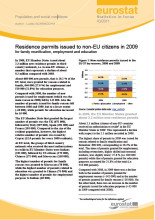
Publication date: 05 September 2011
In 2009, EU Member States issued about 2.3 million new residence permits to third country nationals, i.e. to non-EU citizens, a number that represents a decline of about
0.2 million compared with 2008.
Read more
Main theme: Economic migration, Family reunification, Study § Training, Data & Statistics
Publication Type: Report
Keywords: Eurostat, residence permit

Publication date: 23 August 2011
Here you can find the list of available EMN ad hoc queries circulated between 2008 and 2011.
Read more
Main theme: Cross-sectional, Asylum, Migration
Publication Type: Ad Hoc Queries
Publication date: 24 June 2011
This report has been prepared by Eurostat within the frame of the Zaragoza pilot study on common integration indicators
Read more
Main theme: Data & Statistics
Publication Type: Study
Keywords: EU Migration Policy, Immigrant integration

Publication date: 17 June 2011
This Staff Working Paper of the European Commission is accompanying the Commission Communication to the EP and the Council, within the framework of the Annual Report on Immigration and Asylum 2010
Read more
Main theme: Asylum, Migration
Keywords: annual report, EU Migration Policy
Publication date: 20 May 2011
The Annual Risk Analysis Report of EU Agency FRONTEX, in charge for the coordination of the operational cooperation between Member States in the field of border security
Read more
Main theme: Migration, Borders & Visa, Irregular Migration, Smuggling & Trafficking
Keywords: border control, risk analysis
Publication date: 21 April 2011
Study on unaccompanied minors, carried out by the Risk Analysis Unit of FRONTEX. Amongst others, EMN and the Belgian organisation "Payoke" contributed to this study
Read more
Publication date: 11 April 2011
Council Directive 2003/86/EC of 22 September 2003 on the right to family reunification
Read more
Main theme: Family reunification
Keywords: council directive, family migration policy
Publication date: 11 April 2011
Council Directive 2005/85/EC of 1 December 2005 on minimum standards on procedures in Member States for granting and withdrawing refugee status.
Read more
Main theme: Asylum
Keywords: asylum procedure, council directive, minimum standards
Publication date: 11 April 2011
Council Directive 2004/83/EC of 29 April 2004 on minimum standards for the qualification and status of third country nationals or stateless persons as refugees or as persons who otherwise need international protection and the content of the protection granted
Read more
Main theme: Asylum
Keywords: asylum decisions, council directive, Geneva Convention, qualification directive
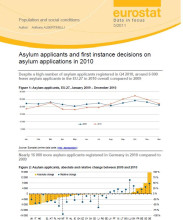
Publication date: 08 April 2011
This Eurostat publication provides a detailed overview of the asylum applications and decisions in the EU27 in 2010.
Read more
Main theme: International Protection, Data & Statistics
Publication Type: Report
Keywords: asylum applications, asylum decisions, Eurostat, first instance, gender, minors of age
Publication date: 28 March 2011
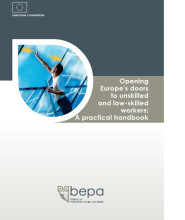
The study, commissioned from IOM by the Bureau of European Policy Advisors (BEPA) provides an inventory of the admission and residence procedures for unskilled and low-skilled third-country workers entering the labour markets of the 27 EU Member States.
Read more
Main theme: Economic migration
Publication Type: Report
Keywords: BEPA, low-skilled workers, unskilled workers
Publication date: 19 January 2011
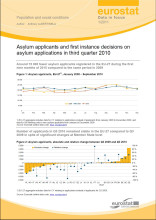
This quarterly Eurostat publication gives an insight into recent developments in international protection including applicants for asylum and decisions on asylum applications. These data are supplied to Eurostat by the national Ministries of Interior and related official agencies.
Read more
Main theme: International Protection, Data & Statistics
Publication Type: Report
Keywords: asylum, asylum applications, asylum decisions, data in focus, Eurostat, first instance, gender, minors of age, outcomes

Publication date: 28 December 2010
Ms Joëlle Milquet, Deputy Prime Minister and Minister for Employment and Equal Opportunities responsible for migration and asylum policy, asked the European Economic and Social Committee to draw up an exploratory opinion on the role of legal immigration in the context of demographic challenges.
Read more
Main theme: Migration
Publication Type: Opinion
Keywords: cultural diversity, demography, fundamental rights, labour demand, legal migration, mobility, non-discrimination
Publication date: 07 October 2010
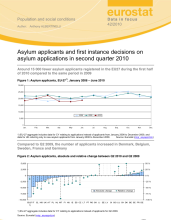
Eurostat states that around 15 000 fewer asylum applicants were registered in the EU27 during the first half of 2010 compared to the same period in 2009
Read more
Main theme: International Protection, Data & Statistics
Publication Type: Report
Keywords: asylum applications, asylum decisions, asylum outcomes, citizenship, comparability, data in focus, Eurostat, first instance, gender, minors of age

Publication date:
The European Commission has launched a new EU-wide awareness campaign to address human trafficking. Under the slogan “End human trafficking. Break the invisible chain”, the initiative seeks to make this often hidden crime more visible to the public. Around 10.000 victims are identified each year across the European Union, while many more remain undetected. The campaign calls on citizens to recognise the signs of exploitation, report concerns and help support victims.
Read more
Main theme: Smuggling & Trafficking
Keywords: awareness campaign, victim of trafficking, signs, indicators, national hotline
Publication date:
The documents set out key elements of the European Commission’s approach to managing international mobility to the EU. The EU Visa Strategy aims to strengthen the Union’s security and integrity through enhanced visa procedures, modernise the processing and management of visas, and support the EU’s economy and competitiveness by facilitating legitimate travel. Complementing this, the Recommendation on Attracting Talent for Innovation provides guidance to Member States on attracting, admitting, and retaining international students, researchers, highly skilled workers, and innovative entrepreneurs.
Read more
Main theme: Economic migration, Study § Training, Borders & Visa
Keywords: visa policy, visa strategy, talent attraction, talent retention
Publication date:
On 29 January 2026, the European Commission presented the first European Asylum and Migration Management Strategy, setting out the Union’s objectives on asylum and migration for the next five years. The Strategy identifies three overarching objectives: preventing irregular migration and disrupting smuggling networks; protecting people fleeing conflict and persecution while preventing abuse of the asylum system; and attracting talent to support the EU economy. It also outlines a set of priorities to guide EU action in the coming years.
Read more
Publication date:
The European Commission has launched the first Annual Migration Management Cycle under the Pact on Migration and Asylum. The cycle provides an annual overview of migration and asylum in the EU and identifies pressures on Member States. It includes the European Annual Asylum and Migration Report, a Commission decision on Member States’ migratory situations, and a proposal for the Annual Solidarity Pool.
Read more
Publication date:
The European Commission has formally established the Network for the Prevention of Child Sexual Abuse. This expert group will bring together policymakers, practitioners and researchers to tackle abuse both online and offline. Prevention efforts aim to protect children and address potential offending behaviour. The initiative forms part of the EU Strategy for a more effective fight against child sexual abuse.
Read more

Publication date:
The European Commission announced that the operations of the Entry/Exit System (EES), an advanced IT system that will digitally record the entries and exits of third-country nationals traveling to 29 European countries for short stays, are set to start on 12 October 2025.
Read more
Main theme: Borders & Visa
Keywords: border management, entry exit system, European Commission
EU allocates €81 billion for migration, border management, and internal security in 2028–2034 budget
Publication date:
On 16 July 2025, the European Commission unveiled its proposal for the 2028–2034 Multiannual Financial Framework (MFF), totalling nearly €2 trillion. A significant portion of this budget—approximately €81 billion—is earmarked for migration, border management, and internal security. Within this amount, €34 billion is specifically allocated to migration management, tripling the funding compared to the previous period.
Read more
Main theme: Cross-sectional, Asylum, Migration
Keywords: multiannual financial framework, European Union, budget
Publication date:
On 11 June 2025, the European Commission published a report reviewing the implementation of the Pact on Migration and Asylum, halfway through its implementation phase, which is expected to be completed by June 2026. The report provides an overview of progress across the main elements of the Common Implementation Plan, while identifying remaining operational and legal challenges. A mid-term review of the Action Plan on Integration and Inclusion 2021–2027 was also released.
Read more
Main theme: Cross-sectional, Asylum, Migration
Keywords: New Pact on Migration and Asylum, implementation, Action Plan on Integration and Inclusion
Publication date:
On 4 June 2025, the European Commission proposed extending temporary protection for displaced persons fleeing the conflict in Ukraine until 4 March 2027. The proposal aims to provide legal certainty to beneficiaries and Member States by maintaining a consistent standard of protection across the European Union. Additionally, the Commission proposed a set of measures to facilitate a coordinated transition out of temporary protection.
Read more
Main theme: Temporary protection
Keywords: Ukraine, displaced person, beneficiary of temporary protection, legal status, voluntary return, reintegration
Publication date:
The European Commission has released new figures revealing a substantial rise in short-stay visa applications to the EU and Schengen-associated countries in 2024. With over 11.7 million applications submitted, the upward trend reflects a continued post-pandemic recovery, although numbers remain below pre-COVID levels. Notably, Bulgaria and Romania began issuing Schengen visas on 31 March 2024, further integrating into the Schengen visa system.
Read more
Main theme: Borders & Visa
Keywords: short stay, visa application, Schengen visa
Publication date:
On 20 May 2025, the European Commission put forward a proposal to revise the rules governing the application of the safe third country concept. The proposal, which inter alia removes the requirement to establish a connection between the applicant and the safe third country, is now subject to approval by the European Parliament and the Council. It has prompted a range of reactions, including expressions of support as well as more critical assessments.