EMN Belgium brings together key stakeholders involved in asylum and migration for its 2025 policy event
On 27 March 2025, EMN Belgium brought together over 130 key stakeholders in the areas of asylum and migration in Belgium. The Minister for Asylum and Migration addressed this large audience of experts from various fields. Participants examined recent developments as well as current and future challenges related to asylum and migration in Belgium and within the EU context. They then explored key topics in breakout sessions and used informal networking opportunities to strengthen connections and explore new collaborations.
The Minister for Asylum and Migration, Anneleen Van Bossuyt, opened the day by addressing the large audience, including representatives from ministerial cabinets, asylum, immigration, and reception authorities, regional administrations, international organisations, civil society organisations, and academia. She presented her priorities and the first achievements of the government agreement on asylum and migration.
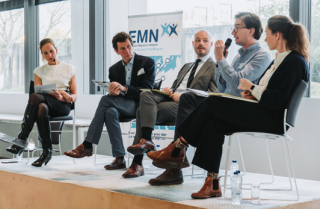
The Minister's speech led to a first panel discussion on the impact of the coalition agreement and the policy statement on asylum and migration in Belgium, with contributions from Evelien Barbieux (Cabinet Van Bossuyt), Joost Depotter (Flemish Refugee Council), Mieke Verrelst (University of Antwerp), and Ina Vandenberghe (Myria). Topics such as asylum and reception, the institutional framework, and legal migration were discussed. While there was an emphasis on the "strictest asylum and migration policy ever" and the need for strong measures in response to the crisis, there was also a call to move beyond a crisis-focused mindset and to act with a long-term perspective, grounded in respect for fundamental rights.
Belgian policy cannot be seen as separate from the European framework. A second panel, with contributions from Stijn De Decker (Immigration Office), Pieter-Jan Van Bosstraeten (Cabinet Van Bossuyt), Mieke, and Joost, provided insights into the implementation of the European Pact on Migration and Asylum and what this entails at the Belgian level. The cabinet clarified the "accelerated" implementation of the Pact as mentioned in the policy statement. Besides this, return was highlighted as a priority and the final piece of the Pact, with a specific focus on the return regulation. Finally, the Belgian strategy regarding temporary protection was discussed.
Participants then delved into various topics during breakout sessions:
- Regional policy changes and common trends regarding labour migration: The law firm Fragomen, specialised in economic immigration law, presented its analysis of the 2024 reforms in the field of labour migration in Belgium. Fragomen noted that the three regions (Brussels-Capital, Flanders, and Wallonia) have introduced numerous changes to the single permit procedure and the rules on work authorisation exemptions. While some measures were described as facilitating the employment of foreign workers—particularly by providing a clearer procedure for low- and medium-skilled workers and relaxing the rules on employer changes for highly skilled workers—Fragomen observed that these are counterbalanced by more restrictive measures. The firm also highlighted that these reforms reinforce the fragmented nature of labour migration law in Belgium. It also remains to be seen whether these reforms will effectively achieve their objectives in practice, namely preventing abuse and improving procedural efficiency.
- The "Reaching Undocumented Migrants (RUM)" project: ICMPD shared insights into its ongoing RUM Project, which focuses on developing evidence-based tools and strategies to enhance outreach efforts and equip professionals with the resources needed to better engage with undocumented migrants. Fedasil presented its Blueprint, a practical guide designed to assist both governmental agencies and civil society organisations in creating locally adaptable systems for supporting undocumented migrants. The Blueprint is grounded in key principles such as a human-centred approach, flexibility, empowering information, multi-stakeholder collaboration, and balancing control with tolerance to create more effective support systems. The Mixed Migration Centre (MMC) shared valuable findings from a recent survey conducted with undocumented migrants from Afghanistan, Algeria, Guinea, Morocco, and Tunisia in Brussels and Paris. The survey revealed that many migrants use a combination of regular and irregular pathways to reach Europe and, over time, seek to regularise their status. It also highlighted how irregular status limits access to essential services like housing and employment, leading to social exclusion. Furthermore, the importance of solidarity networks in sharing information on Assisted Voluntary Return and Reintegration (AVRR) programmes was emphasised. MPI Europe focused on its work to build a strong Community of Practice (CoP), aiming to better understand and analyse what effective counselling involves, how success can be defined and measured, and how to shape impactful conversations that lead to meaningful change in the field. In conclusion, ICMPD outlined the next steps, emphasising the need for continued collaboration between organisations, enhanced outreach and counselling efforts, and the sharing of best practices for frontline workers. These steps aim to strengthen support for undocumented migrants and improve the effectiveness of return and reintegration processes across Europe.
- Family reunification: Astrid Declercq and Céline Lepoivre from Myria, the Federal Migration Centre, provided an overview of the legal framework governing family reunification in Belgium, followed by an explanation of recent legislative changes and their practical implications for those affected. Myria highlighted several key points: (i) while family reunification remains one of the main legal migration pathways in Belgium and primarily benefits EU nationals, the procedure is demanding, with strict conditions (stable employment, income threshold, etc.) and costly, time-consuming requirements (translation and legalisation of documents, proof of family ties, personal submission at diplomatic posts, strict submission deadlines, etc.). Despite the crucial role of professional assistance in navigating these complexities, existing support services struggle to meet the high demand, (ii) the law has been amended several times over the past 20 years. The law of 10 March 2024 represents a new step in this process, aiming to transpose European case law and legislation while also preventing abuse and improper use of the procedure, and (iii) the new government aims to significantly tighten the rules on family reunification, particularly—but not exclusively—for recognised refugees and beneficiaries of subsidiary protection who were involuntarily separated from their family members and cannot continue their family life in their country of origin. The proposed measures raise many legal and practical questions.
- Measures against the sexual exploitation of children, including trafficking: Eric Garbar from the Federal Judicial Police provided an overview of the phenomenon and presented the results of a pilot project aimed at improving the online detection of minors sexually exploited for prostitution, highlighting, among other aspects, the exponential increase in the number of cases. Adrien Cornu from DEI - ECPAT Belgium discussed the work carried out in reception centres to train staff on detecting and reacting to sexual violence, emphasising that two-thirds of personnel are not equipped to identify or respond to such situations. Finally, Sophie Willot from the Samilia association presented awareness-raising workshops for secondary school students, highlighting the lack of awareness among young people about trafficking and prostitution, as well as the reluctance of many schools to address the issue. Stakeholders agreed on three key findings: (1) the current lack of information on the scale of the phenomenon, which remains underestimated and under-investigated; (2) the shortage of resources—such as insufficient personnel, financial means, and technological tools—as well as a lack of adequate training and insufficient accommodation facilities for victims, making it more difficult to combat the issue; and (3) the significant role of digital technologies, which make every child a potential victim, provide criminals with countless opportunities, and constitute a critical success factor for those working to address this issue.
- The Migration Code and the work of the Commission of Independent Experts, set up to support the codification of Belgian immigration law: Luc Leboeuf, co-chair of the Commission, contextualised the long-standing discussion on the need to codify Belgian immigration law, explained how the Commission was structured and how it operated throughout its mandate, and presented the main conclusions from the Commission’s final report, available in French and in Dutch. The following key takeaways can be drawn from this session: (i) the codification of Belgian immigration law is essential for clarity and readability of the subject. The numerous amendments to the law of 15 December 1980, often made on an ad hoc basis, have undermined its readability and overall coherence, (ii) the codification of Belgian immigration law should be carried out with consideration for the implementation challenges of the current legislation, as identified by stakeholders during the broad consultation conducted by the Commission of Independent Experts, which supported part of the codification process under the previous legislature and (iii) this consultation notably highlighted the need to establish legislative conditions for less unilateral administrative action and to prevent excessive fragmentation of the subject, particularly by avoiding the overuse of procedural and material distinctions based on residence status and the quality of the individuals concerned.
- Detecting vulnerabilities among applicants for international protection: Morgane Rousseaux (Bruss’help) outlined the situation of applicants outside the reception network, emphasising their vulnerabilities. Camille Coubeaux (Fedasil) presented a project conducted in collaboration with the Immigration Office, the Guardianship Service, and the Office of the Commissioner General for Refugees and Stateless Persons (CGVS), supported by the European Union Agency for Asylum (EUAA). The project aims to establish a collaborative and streamlined approach to better identify vulnerabilities and specific needs within the asylum and reception process. Gunter Habets (CGVS) introduced another project, the Vulnerability and Asylum project, which addresses the participation of applicants with physical or mental vulnerabilities in asylum procedures, particularly during personal interviews. He emphasised that while vulnerabilities are taken into account in assessments, they alone do not determine eligibility for international protection. He further noted the importance of recognising these vulnerabilities while also valuing the resilience and autonomy of applicants. Key points were raised by stakeholders: (1) applicants face increasing challenges, particularly in the context of the reception crisis, with many single men left on the streets, exacerbating their vulnerabilities and complicating identification and care, (2) there is a need for a common, integrated approach, including a harmonised framework for early detection and assessment of vulnerabilities to improve coordination and ensure humane treatment and (3) strengthening partnerships and collaboration among all stakeholders, including humanitarian actors, is essential to fostering a cohesive and integrated system, while respecting each actor’s mandate.
For more information about the breakout sessions mentioned above, please refer to the PowerPoint presentations below.
The team of EMN Belgium is honoured and grateful to count on such a rich and diverse network of experts! We sincerely thank each and every one of you for your active and essential contributions to the discussions held during the policy event.