Publication date: 27 February 2026
This ad hoc query shines light on the practices applicable in EMN Member Countries regarding applications for family reunification by third-country nationals and their family members who enjoy visa-free travel for short-stays in the EU, in the context of the implementation of the Family Reunification Directive (2003/86/EC).
Read more
Main theme: Family reunification
Publication Type: Ad Hoc Queries
Keywords: application for family reunification, sponsor, residence permit, visa-free travel
Publication date: 06 October 2025
This study provides an overview of legal and policy developments related to the implementation of the Family Reunification Directive since 2017. It examines the current state of national legislation, policies, and practices following two decades of the Directive’s application, incorporating relevant case law and highlighting both challenges and best practices. It also presents data on the scale and evolution of family reunification between 2017 and 2023 (and 2024 where available), drawing on both Eurostat and national sources.
Read more
Main theme: Family reunification
Publication Type: Thematic Studies
Keywords: Family Reunification Directive, application for family reunification, requirement, eligibility, sponsor, family member, digitalisation, access to rights
Publication date: 15 August 2025
This ad hoc query examines how EMN Member and Observer countries verify that third-country nationals applying for residence permits with the purpose of study have sufficient funds to support themselves during their stay. The query also explores trends in the issuance of residence permits for third-country national students and their family members in recent years.
Read more
Main theme: Study § Training
Publication Type: Ad Hoc Queries
Keywords: student, sufficient financial resources, documentary proof, residence permit, application for family reunification
Publication date: 28 April 2025
This ad hoc query compares the existing legislation in EMN Member and Observer Countries regarding the granting of protection statuses to family members of beneficiaries of international protection, as well as recent changes in practices in light of the regime change in Syria.
Read more
Main theme: International Protection, Family reunification
Publication Type: Ad Hoc Queries
Keywords: application for family reunification, Syria, protection status, suspension, decision-making
Publication date: 05 January 2025
This ad hoc query maps the existence of language requirements prior to entry for family members of beneficiaries of international protection. Responding countries also report on experiences with pre-entry language requirements for other categories of residence permits, when applicable.
Read more
Main theme: Family reunification
Publication Type: Ad Hoc Queries
Keywords: application for family reunification, beneficiary of international protection, language requirement, language learning
Publication date: 06 December 2024
This ad hoc query looks into which countries verify that the sponsor who applies for family reunification is not a threat to public order when examining the application for family reunification.
Read more
Main theme: Family reunification
Publication Type: Ad Hoc Queries
Keywords: application for family reunification, sponsor, threat to public order
Publication date: 04 August 2024
This ad hoc query examines the approach taken by EMN Member and Observer countries in relation to applications for family reunification from third-country national workers, in particular with regards to the level of resources and the quality of accommodation required by those applying for family reunification, as well as the possible obligation to provide for medical insurance in the context of such applications.
Read more
Main theme: Family reunification
Publication Type: Ad Hoc Queries
Keywords: application for family reunification, foreign workers, income threshold, accommodation, medical insurance
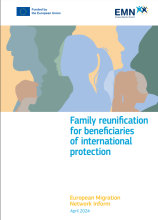
Publication date: 19 April 2024
On the 20th Anniversary of the Family Reunification Directive, this Inform offers a thorough examination of family reunification practices and legislation for beneficiaries of international protection across EMN Member and Observer Countries. It specifically looks at the procedures in place for applying for family reunification and how these have evolved considering recent (since 2017) case law before the European Court of Justice (CJEU), and where relevant the European Court of Human Rights (ECHR).
Read more
Main theme: Family reunification
Publication Type: Informs
Keywords: Family Reunification Directive, beneficiary of international protection, application for family reunification, documentary proof, real family relationship, minors of age
Publication date: 05 January 2024
This ad hoc query provides comparative information on the waiting period that applicants must prove before applying for family reunification in the EMN Member and Observer Countries. It also examines legal time limits for processing an application for family reunification and it clarifies whether such processing time is included in the above-mentioned waiting period.
Read more
Main theme: Family reunification
Publication Type: Ad Hoc Queries
Keywords: application for family reunification, Family Reunification Directive, waiting period, processing time, family reunification right
Publication date: 25 September 2023
This ad hoc query collects information on the submission, processing and examination of applications for family reunification with beneficiaries of international protection. It also focuses on documentary requirements which apply in this context. Finally, it touches upon family reunification with and for children, including children coming of age.
Read more
Main theme: International Protection, Family reunification
Publication Type: Ad Hoc Queries
Keywords: Family Reunification Directive, application for family reunification, evidence, family tie, children

Publication date:
The Belgian Constitutional Court has clarified how the means of subsistence requirement applies in family reunification applications. The ruling establishes that the means of subsistence of both the Belgian sponsor and their partner must be taken into account when assessing compliance with this requirement. Previously, some applications were refused because only the sponsor’s means were considered. The decision aims to ensure compliance with principles of equality, non-discrimination, and respect for family life.
Read more
Main theme: Family reunification
Keywords: Constitutional Court, application for family reunification, income requirement, partner's income

Publication date:
Fragomen will host a webinar on recent changes to Belgium’s immigration policies. The session will cover two main areas: first, new rules in the Flanders Region concerning economic migration, including labour migration pathways, contractual liability, and labour market testing; and second, nationwide modifications affecting family reunification, such as stricter financial criteria for visa applications. The webinar will also highlight practical implications for businesses employing foreign nationals.
Read more

Publication date:
From 18 August 2025, new rules for family reunification enter into force in Belgium. They do not apply to all applicants. Some cases continue under the old rules, others transition to the new rules in 2027, while certain applications are immediately subject to the new framework. This article explains who is affected and how the rules will change.
Read more
Main theme: Family reunification
Keywords: application for family reunification, family tie, income requirement, minimum age, housing

Publication date:
The Belgian Chamber of Representatives has adopted new legislation modifying the conditions for family reunification under the law of 15 December 1980. The changes introduce stricter income requirements and modify waiting periods for certain categories of foreign nationals, particularly those benefiting from international or subsidiary protection. The legislation was approved with a majority vote during a plenary session and aims to regulate access to family reunification, a principal legal pathway for foreign nationals to join family members in Belgium.
Read more
Main theme: Family reunification
Keywords: application for family reunification, income requirement, waiting period, age limit

Publication date:
Myria, the Federal Migration Centre, warns that the measures announced by the federal government in its "Easter Agreement" violate the right to family life. The institution announced in a press release published on Tuesday that it had shared its observations with the government and expressed hope for a constructive dialogue.
Read more

Publication date:
On 11 April 2025, the Belgian Council of Ministers agreed on a package of crisis measures aimed at addressing key issues in the field of asylum and migration. The measures include limitations on reception for asylum seekers, restrictions on subsequent applications for international protection, stricter family reunification conditions, and the termination of integration income for asylum seekers. The four draft bills and the draft royal decree have been submitted to the Council of State for review.
Read more

Publication date:
Myria has published the third thematic section of its 2024 annual report. In this section entitled "Right to family life", Myria calls for more accurate, regular and transparent information regarding the family reunification procedure at its various stages, both at the level of diplomatic posts and external service providers, ensuring the accessibility – including linguistic – of this information for the target audience.
Read more
Main theme: Family reunification
Keywords: long-stay visa, first residence permit, application for family reunification

Publication date:
The law of 10 March 2024 amending the law of 15 December 1980 on the right to family reunification comes into force on 1 September 2024. The changes have an impact among other things on the right to family reunification for parents of accompanied minors with international protection, the right to family reunification for stateless persons, the assessment of minorhood in the asylum procedure or residence procedure for stateless person, etc.
Read more
Main theme: Family reunification
Keywords: right to family reunification, application for family reunification

Publication date:
In a judgement released today, the Court of Justice of the European Union held that an unaccompanied minor refugee, who reached majority during the procedure relating to the application for family reunification with his or her parents, has a right to such reunification.
Read more

Publication date:
According to the Court of Justice of the EU, European Union law precludes national legislation which requires, without exception, that an application for family reunification be submitted in person at a competent diplomatic post.