OECD launches its International Migration Outlook 2025
At the occasion of the publication of the 49th edition of the International Migration Outlook, the OECD organised a launch event including a press conference and a high-level panel discussion. Discussions revolved around the key findings of the report and the future outlook of migration in the EU.
The Organisation for Economic Cooperation and Development (OECD) released the 2025 edition of its International Migration Outlook. This flagship annual publication analyses recent developments in migration movements and monitors recent policy changes in migration governance and integration in OECD countries. This year’s edition includes two special chapters, on the role of firms in immigrant integration and on the international migration of health professionals to OECD countries.
To mark the launch of this year’s edition, OECD Secretary-General Mathias Cormann presented the Outlook’s findings at a press conference on 3 November 2025 in Brussels. Magnus Brunner, European Commissioner for Internal Affairs and Migration, commented on these findings, highlighting the need for labour migration to address shortages on European labour markets, combined with effective asylum systems that promote responsibility-sharing between EU Member States. Emphasis was also placed on the continued fight against irregular migration, including migrant smugglers and human traffickers, and on the need for renewed migration diplomacy efforts to achieve better collaboration with third countries.
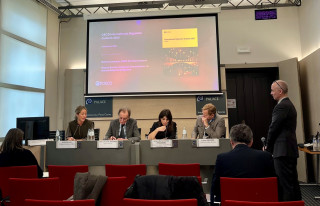
Following the press conference, journalists were invited to attend a panel discussion on “The international migration outlook for Europe and the OECD: challenges and opportunities”, with panelists Gunilla Fincke, Director-General at the German Federal Ministry of Labour and Social Affairs, Chair of the OECD working Party on Migration; Anita Vella, Head of Unit Legal Pathways and Integration, DG Migration and Home Affairs; Ainara Dorremochea Fernández, Deputy Director General of Legal Affairs at the Spanish State Secretariat for Migration, Spain; Lukas Gehrke, Director of IOM Global Office, Brussels; and Jean-Louis De Brouwer, Director of the European Affairs Programme at the Egmont Institute.
Panelists discussed some of the main conclusions drawn in the OECD’s report, notably:
- Migration flows remain high: since 2014, the share of foreign-born rose from 9.1% to 11.5%. At the same time, in most OECD countries, permanent migration declined in 2024 compared to 2023, namely in EU countries. Panelists discussed the historical scale and changing nature of migration.
- Migration and integration policies are going through significant changes: panelists highlighted the contradiction between the evident labour shortages and ageing European population on the one hand, and the strict migration schemes on the other hand. A reconciliation should be made at the political level in order to formulate European policies that attract foreign talent, facilitate legal pathways and boost integration and inclusion.
- Immigrants work disproportionately in lower-paying firms and sectors: the report offers new data on the pay gap between the native-born and the immigrant populations in OECD countries. Such findings call for better diploma and skill recognition mechanisms, language training, and integration measures to boost immigrants’ social mobility. Panelists also discussed the role of the private sector, including SMEs, in addressing this issue.
- OECD health systems continue to rely heavily on migrant doctors and nurses: in 2020‑2021, there were more than 830.000 foreign-born doctors and 1.75 million foreign-born nurses working in the OECD, representing respectively about one-quarter and one-sixth of the workforce in each occupation. Corresponding figures for foreign-trained doctors and nurses are 606.000 (18.4%) and 733.000 (8.3%) in 2021‑2023. Panelists mentioned the issue of brain drain of these professions in countries of origin.
A recording of the event can be found here.
The International Migration Outlook 2025 is now available for download on the OECD website.