
Publication date:
According to preliminary data published by Frontex, the number of irregular border crossings into the European Union decreased by 27% between January and April 2025, compared to the same period in 2024. Nearly 47.000 crossings were detected during the first four months of 2025.
Read more

Publication date:
With only 239 000 irregular crossings into the EU detected in 2024, Frontex reports the lowest number of irregular crossings since 2021, but warns about shifting dynamics and evolving challenges.
Read more
Main theme: Borders & Visa
Keywords: irregular border crossing

Publication date:
According to preliminary data collected by Frontex, the most significant declines in irregular border crossings were observed on the Western Balkan and Central Mediterranean routes, with a 79% and 64% decline, respectively. The Eastern Land Border and Western African routes saw the highest increases, at 192% and 100%, respectively.
Read more
Main theme: Borders & Visa
Keywords: irregular border crossing, migratory route

Publication date:
The number of irregular border crossings into the European Union in the first six months of 2024 fell to roughly 94.000, according to preliminary data collected by Frontex. The Western Balkans and the Central Mediterranean recorded the largest decreases in detections of irregular border crossings, while the West African and the Eastern Land Border have seen the largest increases.
Read more
Main theme: Borders & Visa
Keywords: Frontex, European Border and Coast Guard, irregular border crossing

Publication date:
Frontex revealed today that the number of detections of irregular border crossings at EU’s external borders rose by one fifth (+18%) in the first eight months of 2023 to over 232 350 and that this increase was primarily driven by the number of arrivals through the Central Mediterranean, which remains the main migratory route into the EU.
Read more
Main theme: Borders & Visa
Keywords: irregular border crossing, external border, migratory route

Publication date:
In a press release today, Frontex reported 330 000 irregular border crossings detected in 2022. This is the highest number since 2016 and an increase of 64% from the previous year.
Read more
Main theme: Irregular Migration
Keywords: irregular border crossing, external border
Publication date:
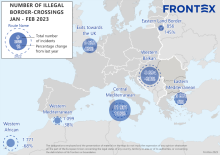
In the first two months of 2023, the number of irregular border crossings reported by national authorities increased to 28 130, roughly in line with the same period last year. The Central Mediterranean and Western Balkan routes remain the most active.